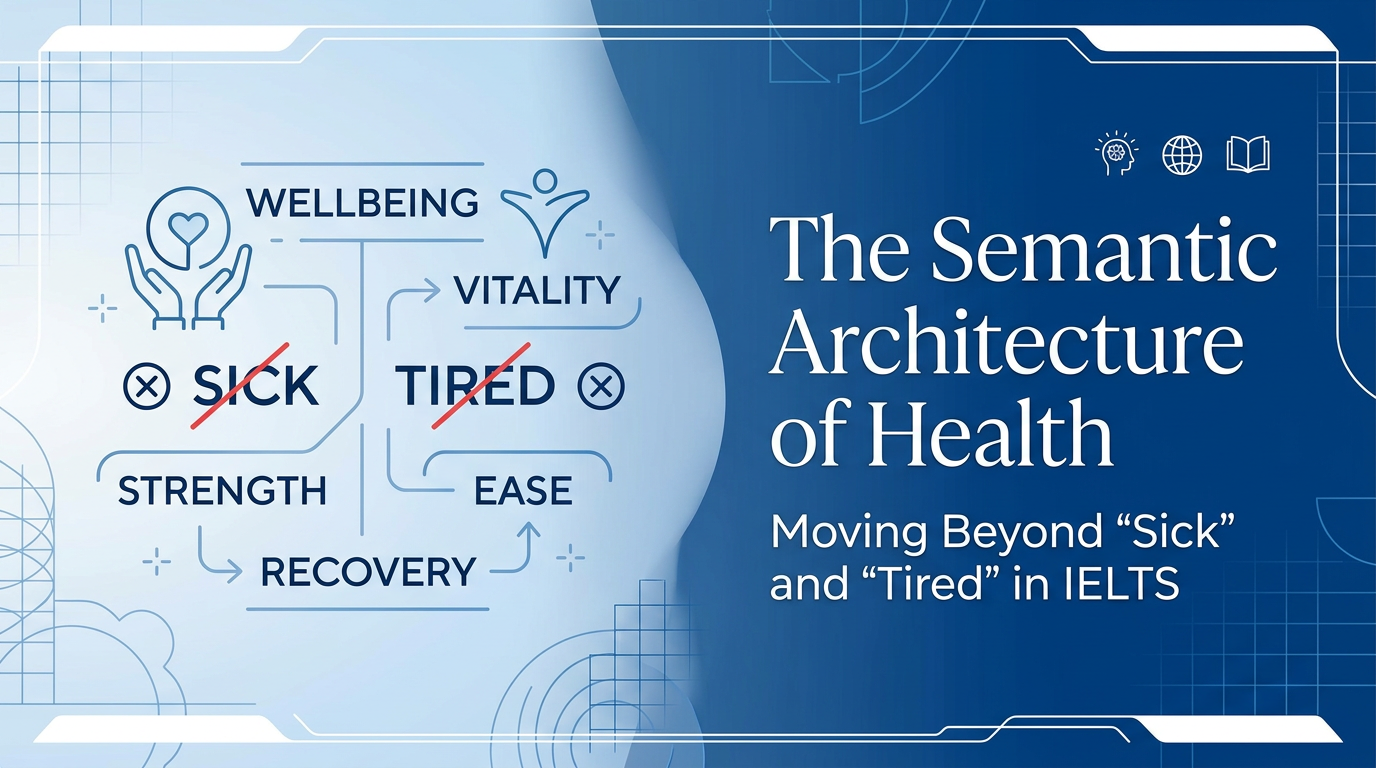
The Semantic Architecture of Health: Moving Beyond 'Sick' and 'Tired' in IELTS
Why is it that two candidates can discuss the same medical topic, yet one receives a Band 6.0 while the other secures an 8.5? The difference rarely lies in their medical knowledge; it lies in their ability to navigate the 'Semantic Gap'—the distance between generic description and lexical precision. To the untrained ear, saying a person is 'very sick' and 'getting better' is accurate. However, to an examiner following the [official IELTS band descriptors](https://www.ielts.org/for-researchers/band-descriptors), these phrases lack the 'precision' and 'flexibility' required for the higher threseholds.
In the realm of health and medicine, the IELTS exam isn't testing your surgical skills; it’s testing your ability to discuss complex societal trends, bioethics, and personal wellbeing with nuance. Recent [research published on ResearchGate](https://www.researchgate.net) indicates that lexical diversity is the highest predictor of success in the Lexical Resource category, yet many students rely on a stagnant pool of 50-100 high-frequency words.
The Fallacy of Topic Lists
Most candidates approach health vocabulary by memorizing lists of diseases. This is a strategic error. In Writing Task 2, you are more likely to be asked about the socio-economic impact of sedentary lifestyles than the symptoms of a specific ailment.
Instead of focusing on nouns (e.g., 'obesity', 'diabetes'), focus on collocation clusters. According to the [Common European Framework of Reference for Languages (CEFR)](https://www.coe.int/en/web/common-european-framework-reference-languages), mastery at the B2/C1 level involves using word combinations that 'sound natural.'
Consider these shifts:
* Basic: "Government should spend money on hospitals."
* Precise: "Governments must allocate significant resources to primary healthcare infrastructure to mitigate the burden on emergency services."
Lexical Precision: The 'Sub-Skill' of Writing Pro
When using tools like Writing Pro, the AI often flags 'overused' vocabulary. In the context of health, terms like 'healthy' and 'unhealthy' are the primary offenders. To move past the 6.5 ceiling, you must categorize your vocabulary into three tiers: The Preventative, The Clinical, and The Systematic.
1. The Preventative (Lifestyle & Public Health)
This is where you discuss 'Global North' issues like sedentary behavior and diet.
* Sedentary lifestyle: A way of life that involves little physical activity.
* Nutritional deficiencies: A lack of essential vitamins/minerals.
* Health literacy: The ability to understand and use health information.
* Preventative medicine: Measures taken for disease prevention rather than treatment.
2. The Clinical (Treatment & Healthcare)
Useful for Speaking Part 3 when discussing doctors and technology.
* Prognosis: The likely course of a disease.
* Acute vs. Chronic: Sudden onset vs. long-term conditions.
* Therapeutic intervention: A treatment intended to relieve or heal a disorder.
* Non-invasive procedures: Medical tests or treatments that do not require cutting the skin.
3. The Systematic (Ethics & Economics)
The bread and butter of Task 2 essays on healthcare funding.
* Universal healthcare: A system that provides health services to all citizens of a country.
* Bioethics: The ethics of medical and biological research.
* Privatization of healthcare: The process of transferring healthcare from public to private ownership.
> Quick Tip: Avoid the word 'pain' if you can describe it. Use adjectives like excruciating, dull, throbbing, or intermittent. This small change demonstrates 'rare lexical items' to the examiner.
The Statistical Reality of Health Trends
To add weight to your Task 2 arguments, you need to understand the 'Double Burden of Malnutrition.' A [study indexed on Google Scholar](https://scholar.google.com/scholar?q=double+burden+of+malnutrition+global+trends) highlights a surprising fact: many developing nations now face the dual challenge of undernutrition and obesity simultaneously. Referencing the 'epidemiological transition'—the shift from infectious diseases to chronic lifestyle diseases—shows a high level of academic sophistication.
Step-by-Step: Constructing a Band 8.0 Response
If you receive a prompt regarding the rising costs of healthcare, follow this lexical roadmap:
By following an AI Roadmap that targets these specific sub-skill analyses, you can see exactly where your vocabulary lacks 'collocational range.'
Common Pitfalls in Health Discourse
According to the [British Council's IELTS resources](https://takeielts.britishcouncil.org/teach-ielts/resources), candidates often struggle with 'appropriacy.' This means knowing when to be formal (Writing Task 2) and when to be conversational (Speaking Part 1). Using an AI Speaking Examiner can help you calibrate this tone in real-time by providing immediate feedback on your register.
Case Study: The '0.5 Delta' in Action
Consider a candidate who used the phrase "people are getting fatter because of fast food." This is a Band 6.0 observation. By utilizing the Growth Engine's daily tasks, they learned to recalibrate this to: "The proliferation of calorie-dense, processed foods is a primary driver of the global obesity epidemic."
This isn't just 'fancy' English; it is precise English. It uses 'proliferation' (growth), 'calorie-dense' (specific type of food), and 'primary driver' (causation). This level of precision is what [experts at the British Council](https://www.britishcouncil.org/exam/ielts) look for when awarding scores of 7.5 and above.
Final Takeaway
Mastering health and medicine vocabulary for IELTS is not about memorizing the dictionary. It is about understanding the relationship between words. If you can pair 'strenuous' with 'exercise,' 'universal' with 'healthcare,' and 'chronic' with 'illness,' you are already halfway to a Band 7.0. Stop learning words in isolation; start learning them in clusters. Your Band Prediction depends on your ability to deploy these clusters under pressure, turning a generic conversation into a sophisticated linguistic display.