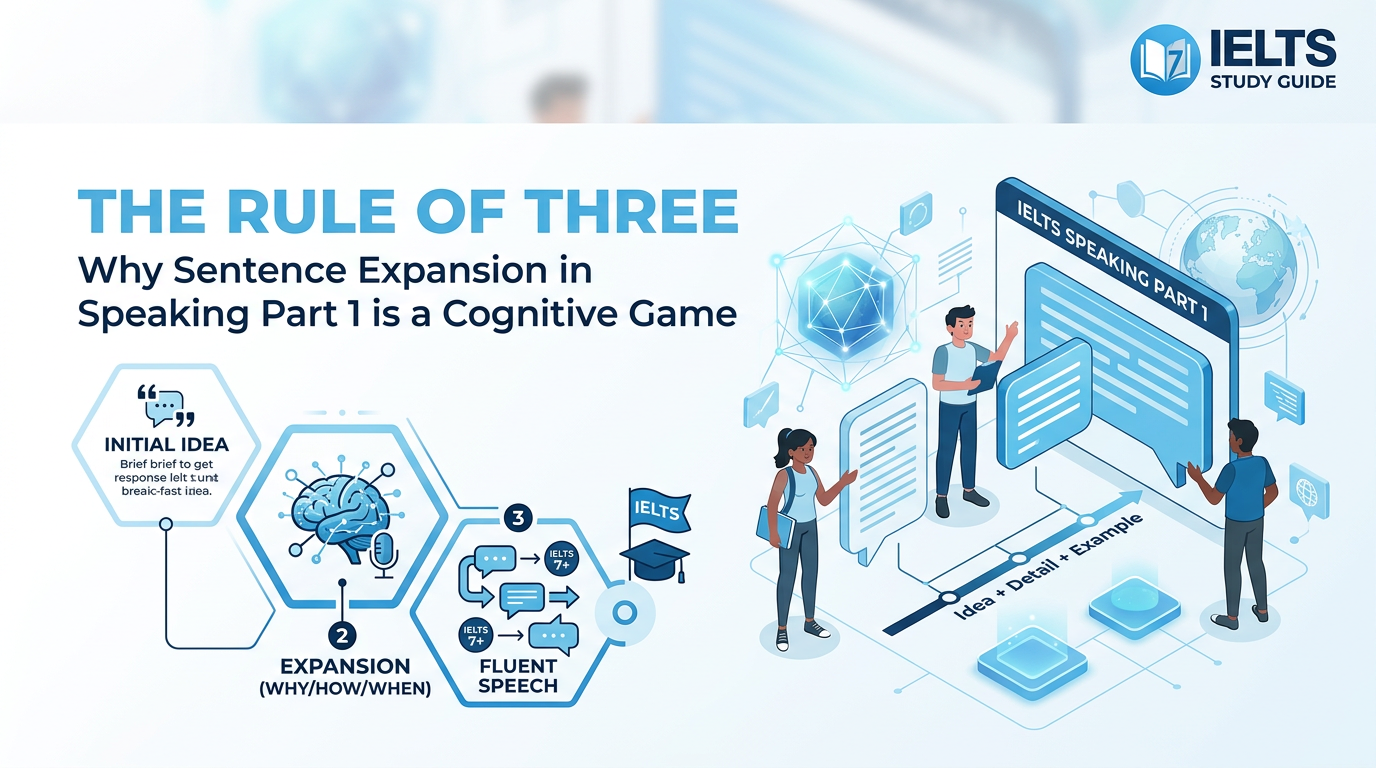
The Rule of Three: Why Sentence Expansion in Speaking Part 1 is a Cognitive Game
The 'Yes/No' Death Trap: Re-engineering Your First Impression
Most candidates approach IELTS Speaking Part 1 as if it were a police interrogation. The examiner asks a question, and the candidate provides a factual, clipped response. However, according to the [official IELTS band descriptors](https://www.ielts.org/for-researchers/band-descriptors), achieving a Band 7.0 or higher in Fluency and Coherence requires the ability to speak at length without noticeable effort or loss of coherence.
Research into second language acquisition suggests that the "fluency gap" isn't just about vocabulary; it’s about cognitive processing speed. A study published on [ResearchGate](https://www.researchgate.net/publication/334235882_Fluency_and_Complexity_in_Second_Language_Speech) indicates that successful speakers utilize 'formulaic sequences' to buy time for complex thought. In Part 1, your goal isn't just to answer—it's to signal to the examiner that you have the linguistic stamina to sustain a conversation.
The Anatomy of the Triple-Extension Technique
To extend naturally, you must move away from the "Because" crutch. Relying solely on the word "because" creates a repetitive syntax that can actually lower your grammatical range. Instead, use the Triple-Extension Technique:
Sample Walkthrough
Question: Do you like the area where you live?
* The Band 5.5 Response: "Yes, I like it because it is quiet and there are parks."
* The Band 7.5+ Response: "Absolutely. It’s a vibrant neighborhood in the north of the city (Direct Answer). I’ve been living there for about five years now, and I particularly enjoy the local cafes (Contextual Anchor). However, it used to be much quieter before they built the new shopping center last year (Contrastive Tail)."
By adding the Contrastive Tail, you demonstrate a variety of tenses—moving from present simple to present perfect and into the used-to structure—without sounding like you’re reading from a textbook.
> Quick Tip: Aim for 2 to 4 sentences in Part 1. If you speak for less than 10 seconds, you aren't showing enough range; if you go over 30 seconds, you risk being cut off by the examiner, which can disrupt your flow.
Overcoming the 'Truth' Bias
One of the most surprising reasons candidates fail to extend their answers is what linguists call the "Truth Bias." Many test-takers search their memory for the perfectly accurate answer, which causes long pauses (filled with 'um' and 'ah'). Evidence from [Google Scholar](https://scholar.google.com/scholar?q=IELTS+speaking+fluency+and+hesitation+markers) shows that hesitation for content—rather than language—is a major hurdle to reaching Band 8.0.
In the Speaking test, you are not under oath. If you are asked about your favorite childhood toy and you can't remember, don't stall. Lying is a valid linguistic strategy. Invent a generic story about a teddy bear or a bicycle to keep the language flowing. The examiner is assessing your English, not your autobiography. Tools like the [AI Speaking Examiner](https://ielts.com) help you practice this 'inventive' fluency by providing real-time prompts that force you to think on your feet.
The Power of 'Discourse Markers' Beyond 'Firstly'
Natural extension requires cohesive devices that don't sound mechanical. The [British Council](https://www.britishcouncil.org/exam/ielts) notes that higher-level candidates use a range of connectives to link ideas. Instead of the standard "Also" or "In addition," try these high-utility phrases:
* To provide a reason: "Essentially, the main draw for me is..."
* To offer a detail: "To be more specific, I'm quite fond of..."
* To show a shift: "That being said, if I had the choice, I’d probably..."
Using these shifts the cognitive load from what you're saying to how you're saying it. If you're struggling to identify which markers you overuse, a [sub-skill analysis](https://ielts.com) can pinpoint specific repetition patterns in your speech, allowing for a more targeted [AI Roadmap](https://ielts.com) for improvement.
Environmental Cues and Semantic Mapping
A lesser-known fact about the IELTS Speaking exam, often discussed in [Wikipedia's entry on the test format](https://en.wikipedia.org/wiki/International_English_Language_Testing_System), is that Part 1 is designed to be "low-stakes" to help you warm up. However, the examiner is already calibrating your potential band score within the first two minutes.
To ensure your extensions don't become circular, use Semantic Mapping. If the topic is "Trees," don't just talk about trees. Map outward to:
* Health: (Oxygen, mental well-being)
* Urbanization: (Concrete jungles vs. green spaces)
* Climate: (Shade, temperature regulation)
This creates a web of related vocabulary. For instance, according to the [BBC Learning English](https://www.bbc.co.uk/learningenglish/english/course/towards-advanced/unit-1/session-1) resources, topical collocations (e.g., "lush greenery," "urban sprawl") are far more effective at boosting your Lexical Resource score than long, obscure words used incorrectly.
Common Mistakes: The Extension Overshoot
While extending is vital, there is a point of diminishing returns. Avoid these three common pitfalls:
The Strategic Path Forward
To move from a Band 6.0 to a 7.5, your extensions must feel like a natural conversation rather than a rehearsed speech. Utilize [Band Prediction](https://ielts.com) technology to record your responses and check your speech-to-silence ratio. Authentic fluency is a balance of speed, appropriate pauses, and the ability to weave secondary details into a primary answer.
Takeaway: Stop trying to be "correct" and start being "descriptive." Use the Triple-Extension technique to anchor your thoughts, and prioritize contrastive ideas to showcase your grammatical range. Your goal isn't to end the conversation—it's to invite the examiner into your world.