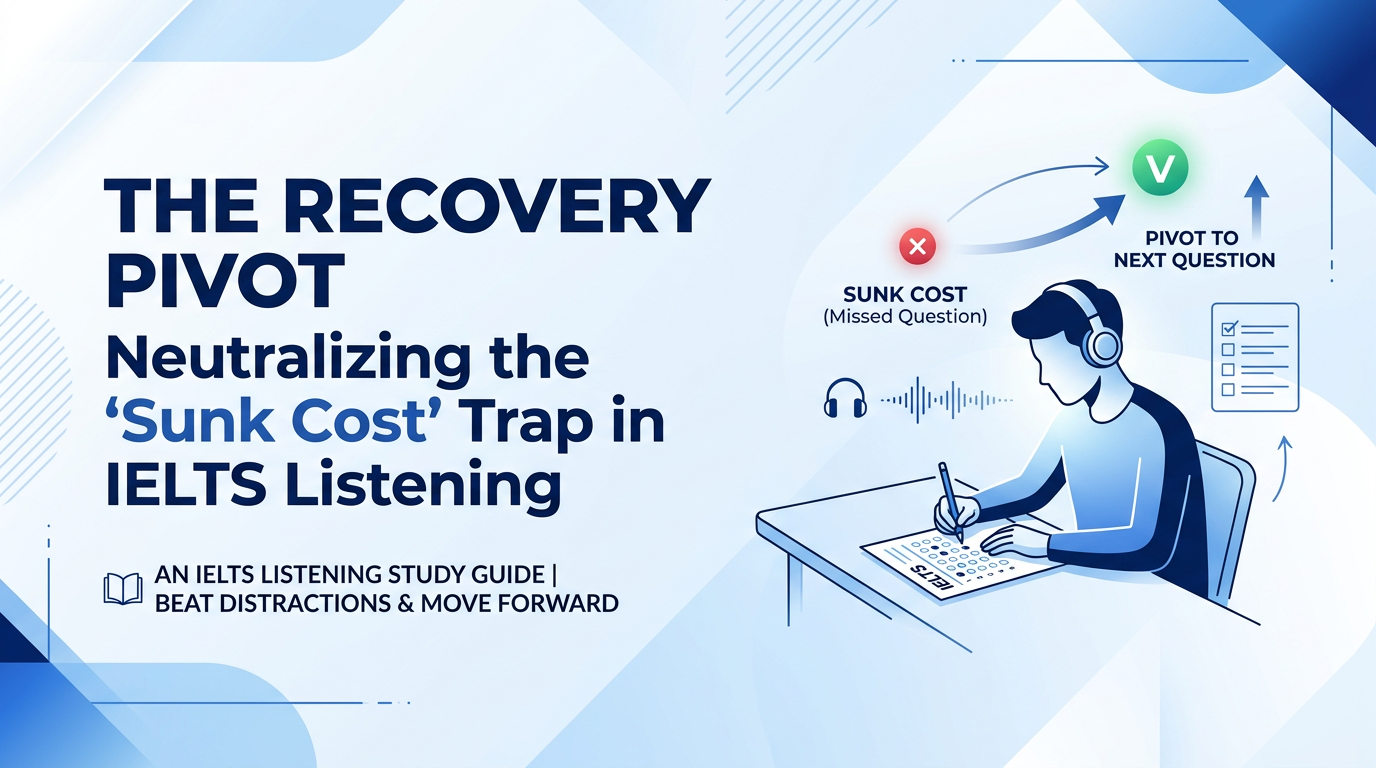
The Recovery Pivot: Neutralizing the ‘Sunk Cost’ Trap in IELTS Listening
It happens in an instant. A sudden cough, a moment of zoning out, or a speaker moving faster than expected, and suddenly, the word you were waiting for is gone. For many candidates, this is the moment the exam begins to unravel. Psychological research into test-taker behavior suggests that the primary driver of score decay isn't the single missed answer themselves, but the cognitive drag caused by attempting to 'hunt' for a lost word while the recording moves forward.
In the world of the [International English Language Testing System (IELTS)](https://en.wikipedia.org/wiki/International_English_Language_Testing_System), your ability to abandon a loss is just as important as your ability to identify a synonym. This article explores the mechanics of the 'Recovery Pivot'—a system designed to protect your remaining marks when a section goes off the rails.
The Psychology of the 'Sunk Cost' in Listening
When you miss an answer in Part 2 or 3, your brain enters a state of 'recursive processing.' You are mentally rewinding the last ten seconds of audio to find the missing piece of information. However, the [British Council](https://www.britishcouncil.org/exam/ielts) notes that the IELTS Listening test is a linear progression; once the audio passes a point, it never returns.
Research on [test-taking strategies](https://scholar.google.com/scholar?q=IELTS+listening+strategies+cognitive+load) indicates that candidates who fixate on a missed item experience a 'rebound effect' where they subsequently miss the next 2 to 3 questions because their working memory is occupied. To reach a Band 7.0 or higher, you must treat every missed question as a 'sunk cost'—an investment that is gone and cannot be recovered.
The 'Anchor Point' Method: Your Emergency Brake
To stop the bleeding after a missed answer, you need to use Anchor Points. These are nouns or numbers in the upcoming questions that are unlikely to be paraphrased.
Step-by-Step Recovery
> Quick Tip: If you realize you've missed an answer in a table-completion task, don't look at the empty box. Move your pencil to the next row immediately. Visual fixation on white space triggers anxiety, which reduces your acoustic processing speed.
The 12-Sub-Skill Factor
High-level performance isn't just about 'hearing' English; it's about managing cognitive load. Our [sub-skill analysis](https://www.ieltsadvantage.com) reveals that 'Information Navigation' is often the weakest link for students stuck at Band 6.0. Using tools like an AI Roadmap can help you identify if your issue is truly listening comprehension or if it’s a failure in 'Signpost Recognition.'
If you find yourself constantly losing your place, your AI Speaking Examiner or listening practice should focus on 'Global Listening'—understanding the structure of the talk rather than just 'Local Listening' for specific words. Platforms like Growth Engine help target these specific weaknesses with daily AI tasks that simulate the 'pressure of the skip.'
Sample Scenario: Part 3 Discussion
Imagine a transcript where a tutor and student are discussing a project on Renewable Energy:
* Question 18: The student was surprised by the cost of ______.
* Question 19: They decided to focus the case study on ______.
If you miss the answer to 18 because the speaker used a complex distractor (e.g., "I thought the environmental impact was the main issue, but actually..."), do not linger. Your eyes should already be on Question 19. If you hear the word "Specifically," or "What about...", the speaker is transitioning.
According to studies on [lexical processing in second language acquisition](https://www.sciencedirect.com), your brain can re-engage with a stream of speech much faster if you stop the internal monologue of "What did he just say?"
Common Pitfalls to Avoid
The Spelling Spiral: Trying to perfectly spell a difficult word (like 'entrepreneur' or 'conscientious'*) while the speaker is already delivering the next answer. Note down a phonetic version (e.g., 'entreprenur') and fix it during the 10-minute check period.
* The 'Wait and See' Fallacy: Thinking the speaker will repeat the information. In IELTS, this almost never happens unless it is a name or number being spelled out in Part 1.
* Ignoring the Band Prediction: If you are consistently missing the middle section of Part 3, your current Band Prediction might be capped by your 'Attention Endurance.' Use Listening Pro modules to build stamina through 40-minute uninterrupted sets.
Tracking Your Recovery Rate
To improve, you need to measure what researchers call the 'Latent Recovery Time.' This is the time between missing an answer and successfully catching the next one.
Effective preparation involves more than just vocabulary; it requires a [personalized study plan](https://www.cambridgeenglish.org/exams-and-tests/ielts/) that treats the test as a psychological challenge. By mastering the 'Recovery Pivot,' you ensure that a single 5-second distraction doesn't define your entire future career or migration path. Focus on the next mark, not the last one.