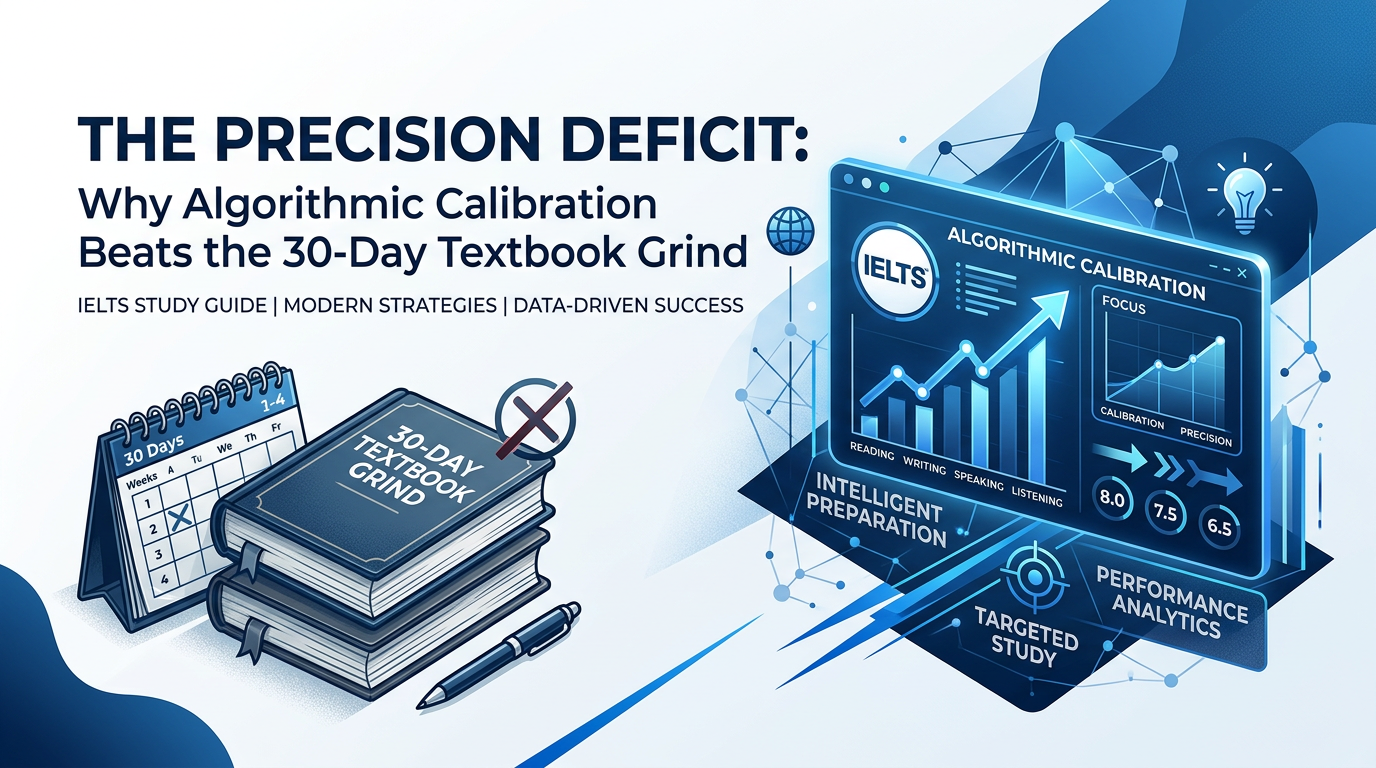
The Precision Deficit: Why Algorithmic Calibration Beats the 30-Day Textbook Grind
Most IELTS candidates approach their preparation like a marathon runner training on a treadmill with no display: they are moving fast, sweating profusely, but have no idea if they are actually gaining ground. For decades, the standard advice has been to follow a linear, 30-day textbook schedule. However, recent shifts in educational technology suggest that these static plans are failing the modern test-taker.
Traditional "generic" schedules operate on the flawed assumption of linguistic uniformity—the idea that every student at a Band 6.0 level struggles with the same nuances. In reality, the gap between a 6.5 and a 7.5 isn't just a matter of 'knowing more words'; it is a matter of granular data calibration. While a textbook treats every chapter with equal weight, a data-driven approach identifies the specific 0.5-band deficits that are holding you back.
The Fallacy of the Linear Syllabus
Standard IELTS textbooks often follow a thematic structure (e.g., 'Environment' in Week 1, 'Education' in Week 2). While this builds vocabulary, it ignores the cognitive load required for specific sub-skills. According to research on [language acquisition patterns](https://www.tandfonline.com), learners do not improve at a uniform rate across all modalities. You might have the lexical resource of an 8.0 candidate but the grammatical range of a 6.0.
A static schedule forces an 8.0-level reader to waste hours on basic scanning techniques simply because it is 'Day 3' of the program. Conversely, a data-driven AI Roadmap bypasses the fluff. By utilizing sub-skill analysis, candidates can pinpoint exactly which of the 12+ sub-skills—such as 'identifying writer's views' or 'distinguishing between facts and opinions'—are dragging down their aggregate score.
The 17% Strategy: Why Targeted Friction Wins
Data from [educational psychology studies](https://scholar.google.com/scholar?q=optimal+challenge+point+learning) suggests that the ‘optimal challenge point’ for learning occurs when a task is roughly 17% beyond a student's current proficiency. Textbooks cannot adjust this difficulty in real-time. If the material is too easy, you plateau; if it’s too hard, you burn out.
Modern Band Prediction tools change the game. By analyzing your performance data in real-time, these systems ensure that your daily AI tasks are perpetually positioned in that 17% 'growth zone.'
Example: Refining the Complex Sentence
Consider this standard response to a Task 2 prompt about technology:
Generic Answer:* "Technology is good because it helps people communicate and work faster."
Data-Refined Answer (Band 7.5+ target):* "While the ubiquity of digital tools has streamlined professional workflows, it has simultaneously introduced a paradox of constant connectivity that may diminish deep-focus productivity."
A textbook tells you to 'use complex sentences.' A data-driven system like Writing Pro detects if you are over-relying on 'while' and 'because,' then pushes you to use 'not only... but also' or 'to the extent that' based on your current lexical variety gaps.
Moving from 'Time Spent' to 'Precision Earned'
In the traditional model, success is measured by chapters completed. In the data model, success is measured by the reduction of 'error clusters.'
According to the [official IELTS band descriptors](https://www.ielts.org/en-us/about-the-test/test-format-in-detail), reaching Band 7.0 in Writing requires a candidate to produce 'frequent error-free sentences.' A generic schedule might give you five practice prompts, but it won't tell you that 80% of your errors occur specifically when using the present perfect tense.
> Quick Tip: The 10-Minute Audit
> Instead of doing a full practice test today, take 10 minutes to review your last three Writing tasks. Circle every preposition. If you find errors in more than 20% of them, stop practicing 'essays' and spend the next three days on Sub-skill analysis specifically for prepositional accuracy.
The AI Speaking Examiner: Breaking the 'Echo Chamber' Habit
Speaking is perhaps where generic schedules fail most spectacularly. Most students practice by recording themselves and listening back—a process that reinforces their own mistakes because they lack the 'trained ear' to spot subtle intonational slips. Recent developments in [AI for language assessment](https://www.cambridgeenglish.org/blog/how-ai-is-transforming-language-assessment/) have made it possible to receive instant phonemic feedback.
Using an AI Speaking Examiner, you get real-time voice practice that identifies 'hesitation markers.' Research indexed on [Google Scholar](https://scholar.google.com/scholar?q=automated+fluency+feedback+IELTS) highlights that candidates who receive immediate feedback on their 'fluency and coherence' improve their score 40% faster than those using self-study methods.
4 Steps to Transition to a Data-Driven Plan
Common Mistakes to Avoid
* The 'Template Trap': Generic plans often provide rigid templates. According to the [British Council's resource archives](https://takeielts.britishcouncil.org/teach-ielts/resources), examiners are trained to penalize 'memorized language.' Data-driven plans encourage 'functional language' instead.
* Ignoring the 'Silent Gap': Many students ignore the 30-second gap in the Listening test. Data-driven practice teaches you how to use that specific window to predict word classes (nouns, verbs, adjectives) rather than just waiting for the audio to start.
* Vocabulary Overload: Learning 50 new words a day is useless if you cannot use them in context. Use [Cambridge University Press](https://www.cambridge.org/elt/blog/) recommended collocation lists rather than isolated word fragments.
The Takeaway: Stop Studying, Start Calibrating
The goal of IELTS preparation isn't to finish a book; it's to eliminate the linguistic markers of a Band 6.0 speaker. Generic schedules offer a sense of security, but data-driven plans offer a sense of certainty. By leveraging sub-skill analysis and real-time AI feedback, you stop working against the clock and start working with your own cognitive patterns. In the high-stakes environment of international migration and education, the most valuable tool is not the textbook—it’s the data that tells you exactly where you stand.