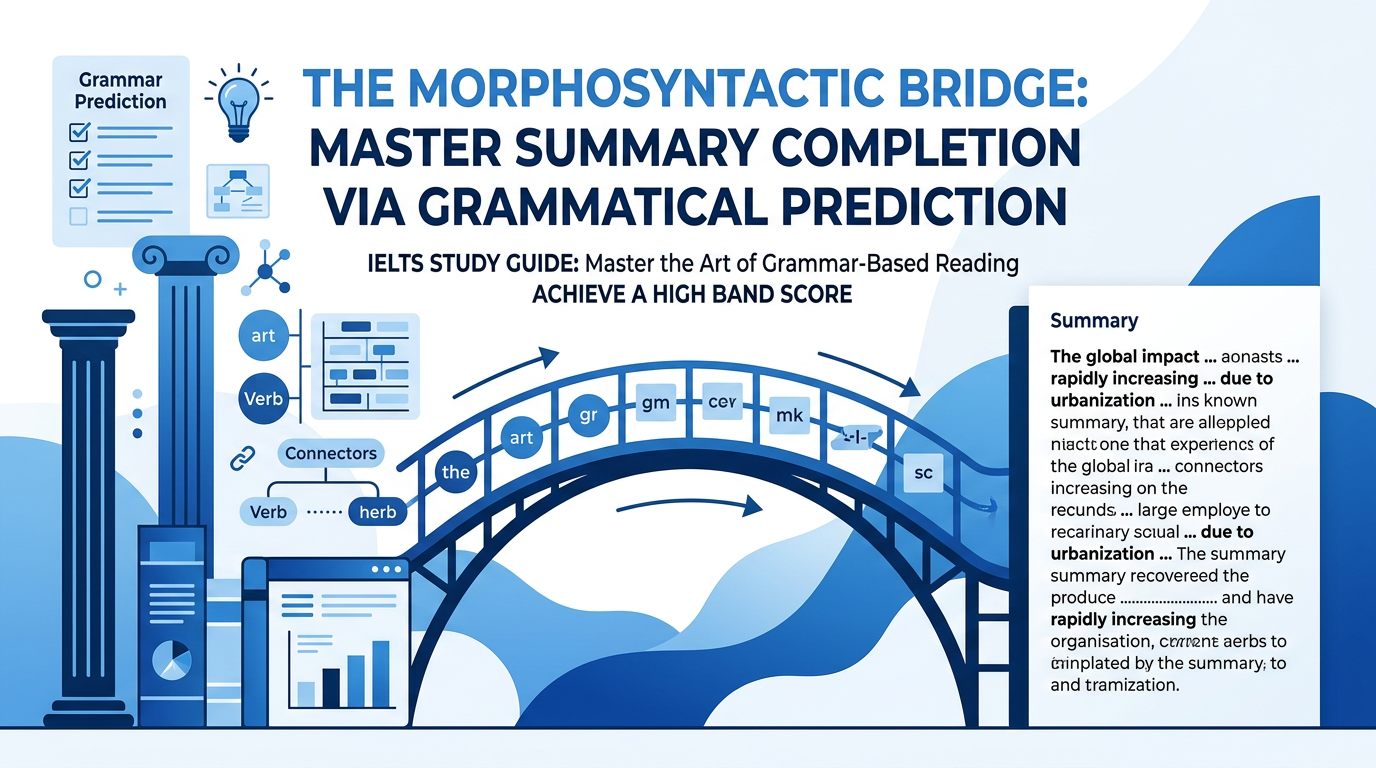
The Morphosyntactic Bridge: Master Summary Completion via Grammatical Prediction
The Hidden Logic of the Gap-Fill
Most candidates approach the IELTS Reading summary completion task as a high-stakes game of 'Where’s Waldo?' They scan frantically for keywords, hoping the answer will leap off the page. However, pedagogical research suggests this 'search-only' method is cognitively inefficient. According to [research indexed on Google Scholar](https://scholar.google.com/scholar?q=cognitive+load+in+second+language+reading+comprehension), excessive scanning without a structural framework leads to 'cognitive overload,' causing students to miss obvious answers tucked behind simple paraphrases.
To move beyond a Band 6.0, you must stop looking for words and start looking for placeholders. Summary completion isn't just a test of your vocabulary; it is a test of your ability to recognize the morphosyntactic bridge—the way the grammar of a summary sentence must mathematically align with the source text, even when the vocabulary changes entirely.
The Anatomy of the 0.8-Second Decision
Expert readers don't read every word. A study published by [ScienceDirect on reading strategies](https://www.sciencedirect.com/topics/psychology/reading-strategies) highlights that 'skipping' is a vital component of fluent comprehension. In the context of the Growth Engine’s sub-skill analysis, we see that high-scorers spend approximately 30% less time on the source text because they pre-process the summary first.
Before you even look at the passage, you should know three things about each gap:
> Quick Tip: If the gap follows a preposition like 'between' or 'among,' you are almost certainly looking for a plural noun or two distinct entities. If the gap follows 'the,' you are looking for a specific noun or an adjective-noun pair.
The Triple-Layer Prediction Method
To refine your approach, use this tripartite strategy used by top-tier candidates to stabilize their [Band Prediction](https://www.cambridgeenglish.org/exams-and-tests/ielts/results/) scores during practice sessions.
1. Identify the 'Anchor' Word
An anchor word is a name, date, or technical term within the summary that is unlikely to be paraphrased. For example, if the summary mentions "the 19th-century hydro-electric project," the date and the specific term 'hydro-electric' are your anchors. Use these to locate the relevant paragraph in the text.
2. Map the Logic, Not the Lexis
Summaries often condense two or three paragraphs into four or five sentences. This means the summary uses cohesive devices that might be different from the text. While the text might use a 'cause-and-effect' structure, the summary might use a 'contrast' structure. According to the [Common European Framework of Reference for Languages (CEFR)](https://www.coe.int/en/web/common-european-framework-reference-languages/level-descriptions), mastering these connective transitions is what separates B2 users from C1 practitioners.
3. The Collocation Check
Once you find a potential word, plug it into the gap. Does it sound natural? The [British Council's guide to IELTS preparation](https://www.britishcouncil.org/exam/ielts/prepare) emphasizes that many errors occur because students choose a word that fits the meaning but violates English collocations.
Example Walkthrough:
* Summary: Residents were surprised by the ______ of the new zoning laws.
* Source Text: "The local community was caught off guard by how strictly the new land-use regulations were enforced."
* Analysis: The gap follows 'the' and precedes 'of.' We need a noun. The text says they were caught off guard by "how strictly... [they] were enforced." The noun form of 'strict' is 'strictness,' and the noun form of 'enforced' is 'enforcement.' Both fit grammatically, but 'enforcement' is the standard academic collocation for laws.
The "Word Bank" Trap
There are two types of summary completion: those with a provided box of words and those where you must pull words directly from the text.
If you have a Word Bank, the challenge is doubled. You aren't just looking for a synonym; you are looking for a synonym of a paraphrase. A study on [lexical diversity in testing](https://www.tandfonline.com/action/doSearch?AllField=lexical+diversity+IELTS) shows that these tasks specifically target your knowledge of 'low-frequency' synonyms. If the text says "diminished," the word bank might use "curtailed."
If you are using our AI Roadmap for self-study, focus your Reading Pro sessions on these 'synonym-matching' drills. The AI will flag if you are consistently missing answers because of a lack of 'tier 2' academic vocabulary.
Common Pitfalls to Avoid
Quantitative Efficiency: The 90-Second Rule
In a standard 60-minute Reading exam, you have roughly 1.5 minutes per question. However, summary completion questions are often 'clustered.' You should aim to complete a 5-gap summary in under 6 minutes.
* Minute 1: Read the summary, predict parts of speech, and circle anchors.
* Minutes 2-5: Locate the section in the text and extract words.
* Minute 6: Final grammar check (plurals, spelling, and word count).
For more advanced practice, tools like the [BBC Learning English IELTS section](https://www.bbc.co.uk/learningenglish/english-at-university/ielts-preparation) offer excellent deep-dives into the types of complex academic texts you will encounter.
Strategic Synthesis
Mastering summary completion requires a shift in perspective: stop seeing it as a vocabulary test and start seeing it as a structural puzzle. By identifying the morphosyntactic requirements of the gap before you scan the text, you reduce the 'noise' and focus only on relevant data. Utilize the sub-skill analysis in your daily practice to determine if your weakness lies in vocabulary range or grammatical precision. The goal isn't to find the right word; it's to eliminate every word that cannot be right until only the truth remains.