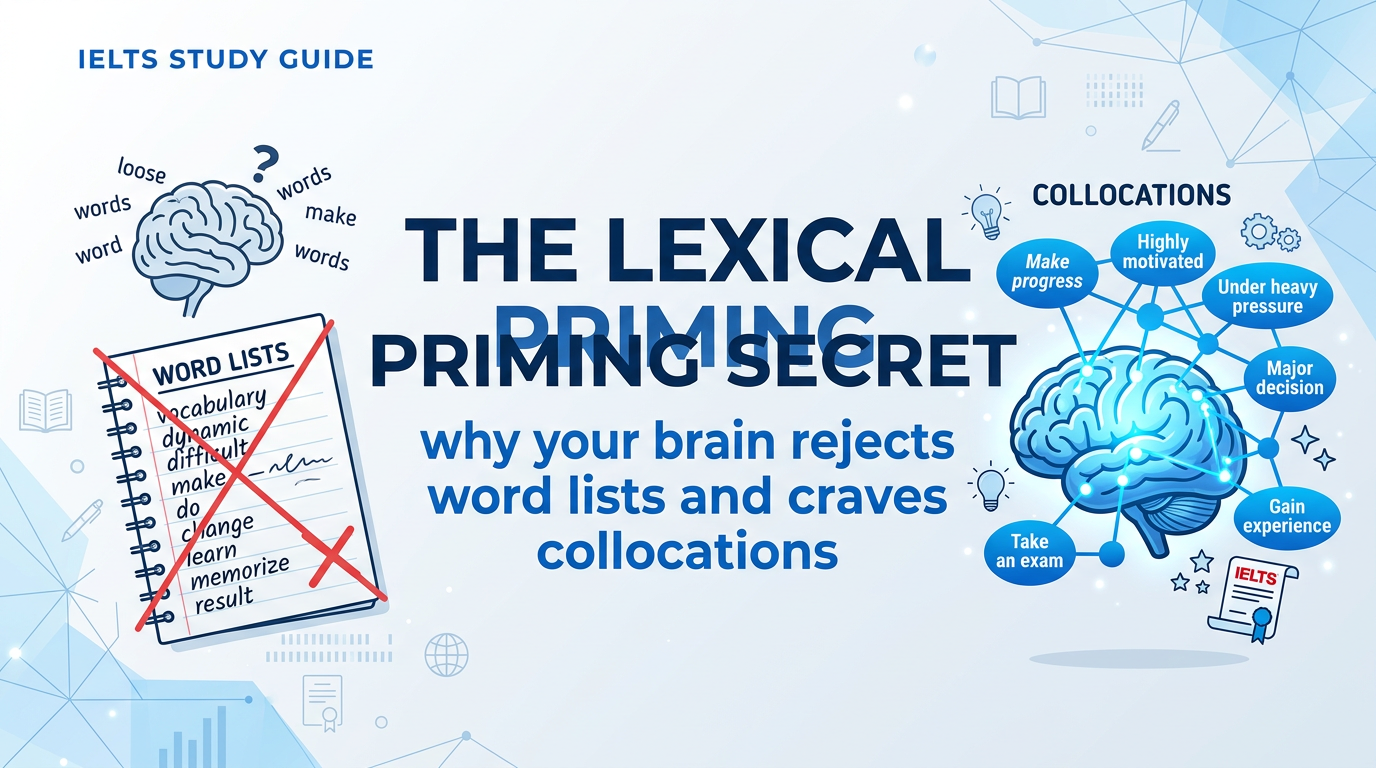
The Lexical Priming Secret: Why Your Brain Rejects Word Lists and Craves Collocations
Imagine you are in the middle of your IELTS Speaking Part 2. You want to describe a busy city. Your brain reaches for the word 'big' or 'noisy,' but you feel these are too simple. You search your mental 'word list' for a synonym you memorized last night: 'turbulent.' You say, 'The city had turbulent traffic.' The examiner winces slightly. Why? Because while 'turbulent' means chaotic, native speakers almost never pair it with 'traffic.' You’ve fallen into the 'synonym trap.'
Research into [Lexical Priming](https://en.wikipedia.org/wiki/Lexical_priming) suggests that our brains do not store language as individual units, but as interconnected clusters. When you force your brain to memorize isolated lists, you are fighting against the natural architecture of human memory. To move from a Band 6.0 to a Band 7.5, you must stop being a 'word collector' and start becoming a 'pattern hunter.'
The Failure of the 1,000-Word List
Many candidates believe that if they simply memorize the 'Top 100 Academic Words,' their Lexical Resource score will skyrocket. However, the [official IELTS band descriptors](https://www.ielts.org/for-researchers/band-descriptors) for Band 7 and 8 specifically look for 'collocational precision.' This refers to the natural partnership between words.
Evidence from [Cambridge University Press](https://www.cambridge.org/elt) indicates that high-scoring candidates do not necessarily use more difficult words; they use common words with higher accuracy in pairing. For example, you don't 'make' a crime; you 'commit' one. You don't have a 'big' chance; you have a 'golden' opportunity. These pairings are what give your speech and writing that elusive 'natural' flow.
The Science of 'Chunks' over 'Bits'
Why are collocations so much more effective than lists? It comes down to cognitive load. When you speak, your brain has to manage grammar, pronunciation, and content simultaneously. If you store 'environmentally friendly' as two separate words, your brain has to perform two 'retrieval acts.' If you store it as a single 'chunk,' it counts as one.
Studies indexed on [Google Scholar](https://scholar.google.com/scholar?q=formulaic+language+ielts+success) show a direct correlation between the use of formulaic language and higher scores in fluency. By using our Sub-skill analysis, we’ve found that students who struggle with speaking time often lack these 'chunks,' causing them to pause frequently as they assemble sentences word-by-word.
How to Build a Collocation Map
Instead of a vertical list, create a 'Collocation Map.' Take a central topic, like 'Technology,' and branch out using different grammatical structures:
To ensure you are finding authentic pairings, use a [Corpus-based approach](https://www.tandfonline.com/action/doSearch?AllField=collocation+learning+strategies). A corpus is a massive database of real-world language that shows you which words actually 'hang out' together. This method moves you away from the 'translation' mindset and toward an 'immersion' mindset.
Practical Walkthrough: The 'Mitigate' Example
Let’s look at a typical Writing Task 2 topic: Climate Change.
* The List Method: A student learns 'Mitigate' = 'to make less severe.' They write: 'We must mitigate the hot weather.' (Incorrect usage).
The Collocation Method: A student learns 'Mitigate' in context via Writing Pro. They see it paired as: Mitigate the effects, mitigate the risk, mitigate the impact.*
By learning the 'neighborhood' of the word, the student writes: 'Governments must implement green policies to mitigate the environmental impact of industrialization.' This sentence earns a high score not just because of the 'big word,' but because it is used with surgical precision.
The Role of 'Active Noticing'
According to pedagogical research published by [TESOL](https://www.tesol.org), 'noticing' is the most critical stage of language acquisition. You cannot just read; you must hunt. When reading an article from an authoritative source, don't look for new words. Look for how the words you already know are being used in new ways.
If you use a tool like an AI Roadmap, your daily tasks should focus on this 'active noticing.' Instead of asking yourself 'What does this word mean?', ask 'What words are next to it?' This shift in perspective is what separates a Band 6.5 student from a Band 8.0 student.
The 'Band Prediction' Reality Check
Many students ask why their Band Prediction stays stagnant despite learning 50 new words a week. The reason is usually 'over-sophistication.' In an attempt to sound academic, students often use collocations that are technically correct but contextually 'clunky.'
As noted by [IELTS Liz](https://ieltsliz.com/ielts-vocabulary-collocations/), examiners value clarity over complexity. Using a simple phrase like 'vastly improved' correctly is much better than using a complex phrase like 'meliorated significantly' incorrectly.
Your 3-Step Action Plan
Final Takeaway
Collocations are the 'glue' of the English language. Without them, your English is just a pile of bricks—technically there, but not yet a house. Stop treating vocabulary like a shopping list and start treating it like a social network. If you know who a word 'hangs out' with, you truly know the word.