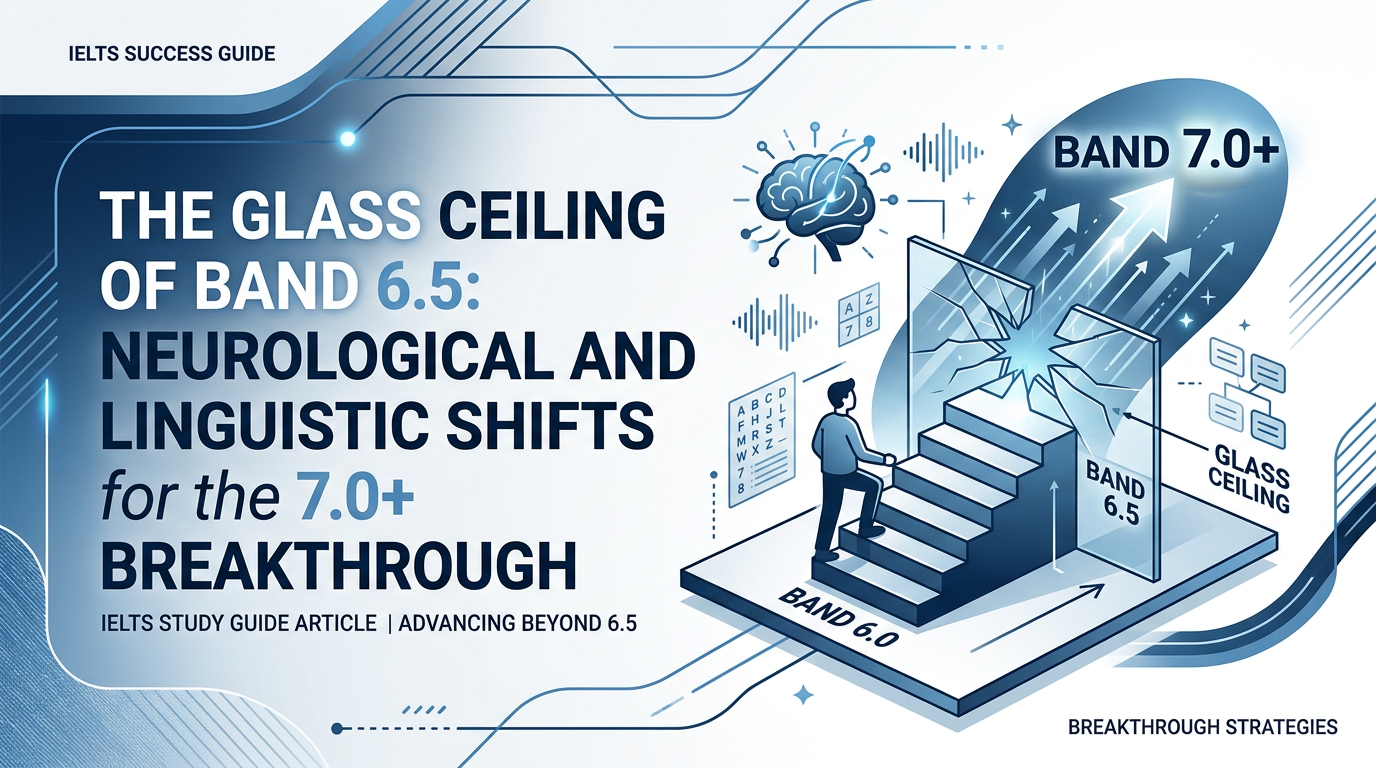
The Glass Ceiling of Band 6.5: Neurological and Linguistic Shifts for the 7.0+ Breakthrough
Why is 6.5 the most common resting place for IELTS candidates? You have mastered the basics. You can hold a fluent conversation and generate complex sentences. Yet, the leap to Band 7.0 feels like an invisible wall.
Research suggests this isn't just a lack of 'study time.' It is a phenomenon known as the Intermediate Plateau. According to the [Common European Framework of Reference for Languages (CEFR)](https://www.coe.int/en/web/common-european-framework-reference-languages), moving from B2 (Band 6.5) to C1 (Band 7.0+) requires a fundamental shift from 'communicative competence' to 'linguistic precision.'
To break through, you must stop 'practicing' and start 're-engineering' how your brain processes English.
The 'Lexical Precision' Gap
At Band 6.5, candidates often use 'topic-related vocabulary.' However, the [official IELTS band descriptors](https://www.ielts.org/for-researchers/band-descriptors) for Writing Task 2 specify that a Band 7.0 candidate uses 'less common lexical items with some awareness of style and collocation.'
The difference is subtle. A 6.5 candidate might write: "Technology has many benefits for education." A 7.5 candidate writes: "The proliferation of digital tools has fundamentally restructured pedagogical frameworks."
It isn't about using 'big words'; it’s about collocational accuracy. Research indexed on [Google Scholar](https://scholar.google.com/scholar?q=collocation+competence+in+L2+writing) shows that higher-band achievers don't necessarily know more words—they know how words behave in pairs.
1. Tactical Decoupling: A Three-Step Re-Engineering Method
To move past the plateau, you must decouple your thoughts from your native language structure.
> Quick Tip: The difference between a 6.5 and a 7.5 in Speaking is often the 'Fluency and Coherence' marker. Stop using 'well,' 'uhm,' and 'actually.' Replace them with 'discourse markers' that signal the direction of your thought, such as "Concomitantly," or "From a longitudinal perspective..."
2. The Cognitive Load of Listening and Reading
In the Listening module, the plateau often happens because the brain 'maxes out' its cognitive load during Section 3 and 4. A study published on [ResearchGate](https://www.researchgate.net/publication/313888320_The_Role_of_Working_Memory_in_L2_Listening) suggests that working memory capacity is the primary differentiator between B2 and C1 listeners.
To combat this, utilize the Growth Engine approach: daily high-intensity tasks that push your auditory processing speed. Listen to podcasts at 1.25x speed and attempt to summarize the main argument in under 30 seconds. This 'over-training' makes the actual IELTS exam feel slow by comparison.
3. Grammatical 'Flexibility' vs. 'Correctness'
Many 6.5 students focus on not making mistakes. However, the [British Council's teaching resources](https://takeielts.britishcouncil.org/teach-ielts/resources) emphasize that for Band 7, you need a 'range of complex structures.'
* 6.5 Approach (Safe): "If we protect the environment, the world will be better."
* 7.5+ Approach (Flexible): "Were governments to prioritize ecological preservation, a more sustainable global trajectory might be realized."
Using inversion (Were governments to...) and modal verbs of probability (might be realized) demonstrates a level of control that examiners look for when awarding the higher tiers. You can practice this in real-time with an AI Speaking Examiner, which can flag when your sentence structures become repetitive or overly simplistic.
Common Mistakes to Avoid at the 6.5 Mark
* The Over-Generalization Trap: Using words like 'everyone,' 'always,' or 'never.' Higher bands require hedging (e.g., 'frequently,' 'it is arguably the case that').
The 'Quantity over Quality' Mock Test Loop: Taking 50 practice tests without analyzing why* you got the answers wrong. Use Band Prediction tools to see if your errors are semantic (misunderstanding words) or structural (losing the logic).
* Ignoring Cohesion: A 6.5 student uses 'Firstly, Secondly, Finally.' A 7.5 student uses 'This phenomenon,' 'Such initiatives,' or 'The former policy.' This is known as cohesive referencing, as detailed in [Wikipedia's IELTS overview](https://en.wikipedia.org/wiki/International_English_Language_Testing_System).
4. Evidence-Based Reading Strategies
In Reading, the plateau usually stems from a lack of 'syntactic parsing'—the ability to break down long, complex sentences quickly. [BBC Learning English](https://www.bbc.co.uk/learningenglish/english/course/towards-advanced/unit-1/session-1) offers advanced courses that focus on 'reading between the lines,' which is vital for the 'Writer's Purpose' and 'Yes/No/Not Given' questions.
Instead of searching for keywords, find the functional meaning of the paragraph. Is the author criticizing, supporting, or remaining neutral? Band 7+ requires you to identify the 'tone' as much as the 'fact.'
Final Breakthrough: The AI Roadmap
Breaking the 6.5 barrier requires shifting from a student mindset to an investigator mindset. Use a personalized AI Roadmap to identify which of the 12+ sub-skills is dragging your average down. Whether it is 'Lexical Resource' in Speaking or 'Task Response' in Writing, targeted intervention is the only way to move the needle.
The plateau is not a ceiling; it is a sign that your current methods have taken you as far as they can. By increasing your lexical precision and mastering complex grammatical flexibility, you move from someone who speaks English to someone who commands it.