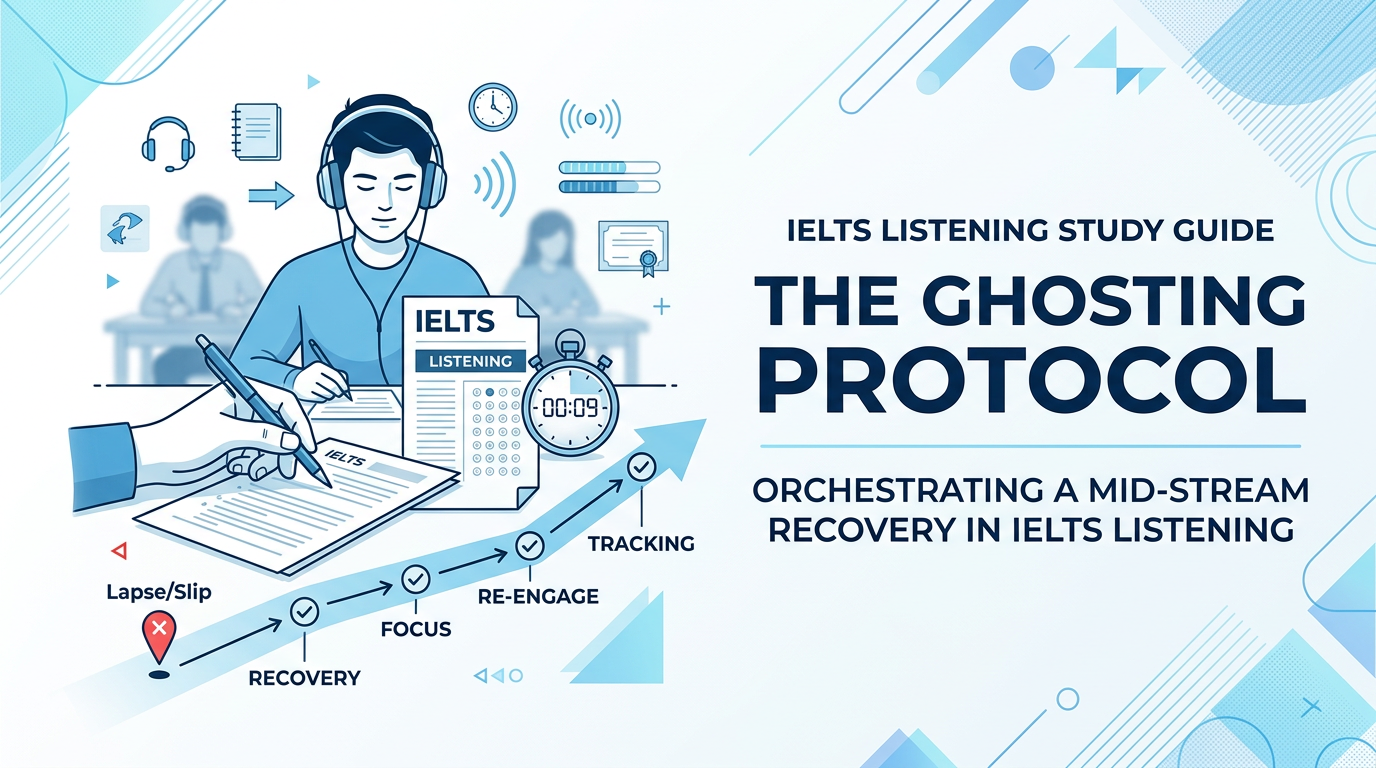
The Ghosting Protocol: Orchestrating a Mid-Stream Recovery in IELTS Listening
Imagine you are in the middle of Section 3 of the IELTS Listening paper. Two university students are discussing a project on renewable energy. You see the keyword 'biomass' on your question paper, but as the speaker continues, you realize they have already transitioned to 'geothermal.' You missed the gap-fill answer for Question 24.
In that microsecond, your brain experiences what cognitive scientists call 'attentional blink.' According to research on [auditory processing speed indexed on Google Scholar](https://scholar.google.com/scholar?q=auditory+processing+speed+and+second+language+listening), the human brain requires roughly 200–500 milliseconds to recover from a cognitive shock. In the context of the [IELTS Listening test](https://en.wikipedia.org/wiki/International_English_Language_Testing_System), those 500 milliseconds are the difference between missing one answer and missing a whole string of four.
The Psychology of the 'Sunk Cost' in Auditory Processing
Most candidates fall into a psychological trap: they try to 'reconstruct' the missed word while the audio continues. This is a fatal error. The [British Council's assessment guidelines](https://www.britishcouncil.org/exam/ielts) emphasize that the recording is played only once. When you mentally look backward, you create a cognitive deficit for the incoming information.
Statistically, candidates aiming for a Band 7.0 or higher cannot afford to lose more than 10 marks across the 40 questions, as outlined in the [official IELTS scoring tables](https://www.ielts.org/for-test-takers/how-ielts-is-scored). If you miss one answer, you are still in the 9.0 range. If you let that one miss distalize your focus, you risk a 'cascade failure' where an entire section represents a score-killing void.
The ‘Ghosting’ Protocol: A 3-Step Recovery
To master the art of the recovery, you must employ the 'Ghosting' protocol. This is a tactical abandonment of the lost data point to secure the safety of the next one.
1. The Immediate Semantic Pivot
The moment you realize the audio has moved past your current question, draw a horizontal line through the blank space on your question paper. This physical act signals to your brain that the 'transaction is closed.' It prevents you from wasting RAM (working memory) on guessing.
2. Identifying the 'Anchor' Keyword
Look ahead immediately. Do not look at the question you just missed; look at the next two questions. Underline the 'anchors'—these are usually proper nouns, numbers, or technical terms that the speaker is unlikely to paraphrase.
3. The Breathing Reset
Take a sharp, silent inhale. This physiological reset helps break the 'freeze' response. By the time the speaker mentions your new anchor, you should be fully recalibrated.
Why Sub-Skill Analysis is Your Safety Net
Recovering in the moment is a manual skill, but prevented failure comes from training your sub-skills. In our Sub-skill analysis framework, we often find that students who struggle with recovery actually have a deficit in 'Signposting Recognition.' According to [pedagogical resources from Cambridge University Press](https://www.cambridge.org/elt), understanding how speakers transition (e.g., "Moving on to...", "If we look at the other side...") is the primary defense against getting lost.
By using a tool like the Growth Engine, you can target these specific transitions in daily AI-driven tasks. Instead of just doing full tests, you practice the sub-skill of 're-entry'—intentionally skipping an answer and forcing yourself to catch the next one.
> Quick Tip: If you miss an answer in a multiple-choice section (Section 2 or 3), do not leave it blank. Wait for the 10-minute transfer time at the end of the test to make an educated guess based on the context of the surrounding discussion. Never guess while the audio is still playing.
Case Study: The Section 4 'Technical Drift'
Section 4 is often a monologue. Here, a miss is most dangerous because there are no pauses between speakers to help you reset.
Example Scenario:
* Question 37: The lecture mentions that the main cause of soil erosion was ________.
* Question 38: The local government decided to implement a ________ program.
If you are listening for 'soil erosion' and suddenly hear the lecturer say, "Consequently, the municipal authorities launched a reforestation initiative," you have missed 37.
* The Wrong Move: Thinking, "Was it wind? Was it overgrazing? I think I heard 'farming'."
* The Recovery Move: Instantly recognizing 'municipal authorities' as a paraphrase for 'local government.' You write 'reforestation' in slot 38 and move your eyes to 39 immediately.
As noted in the [TESOL international standards for listening comprehension](https://tesol.org), the ability to map synonyms in real-time is a high-level cognitive task. If you are stuck on the 'soil' question, your brain cannot process the 'municipal/reforestation' synonym mapping.
Common Recovery Mistakes to Avoid
Building Your Recovery Roadmap
If your Band Prediction is currently plateauing around 6.0, the issue might not be your vocabulary, but your 'recovery endurance.' Use your AI Roadmap to schedule 'distraction training.' This involves listening to academic podcasts from sources like [BBC Learning English](https://www.bbc.co.uk/learningenglish) and intentionally looking away for 5 seconds, then tasking yourself to find exactly where the speaker is.
This kind of training builds the neural pathways necessary to handle the high-pressure environment of the exam room.
The Final Word on Resilience
An 8.5 listener is not someone who hears every word perfectly; they are someone who knows how to navigate the gaps. Treat every missed answer as a 'lost pawn' in a chess game. You can lose a pawn and still win the match, provided you don't lose your King (your focus) in the process. Ensure your AI Speaking Examiner and Listening Pro sessions include 'hard mode' settings where you practice re-engaging with the text after a simulated disruption. Recovery is not a sign of weakness; it is a core component of linguistic fluency.