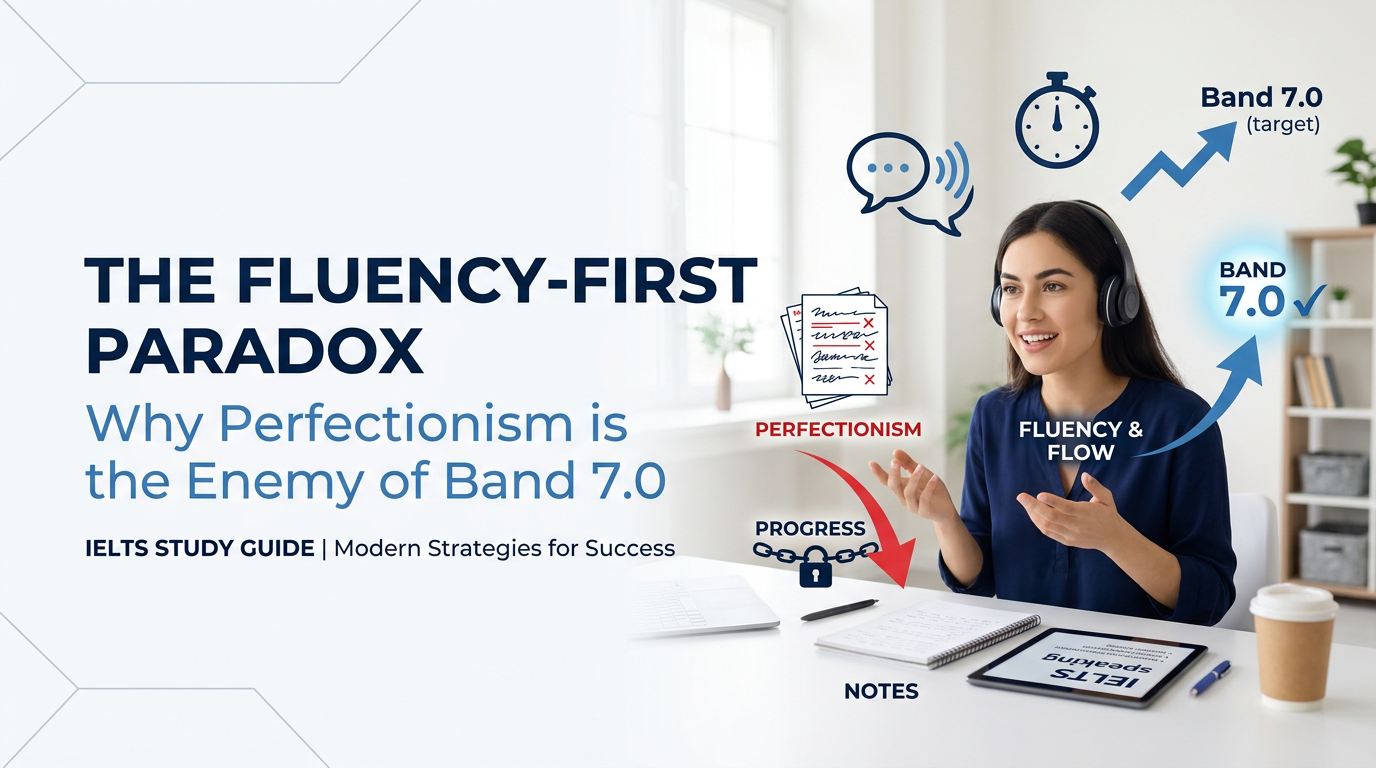
The Fluency-First Paradox: Why Perfectionism is the Enemy of Band 7.0
Imagine you are sitting across from an examiner. You have a choice: speak slowly and meticulously to ensure every verb tense is perfect, or speak with natural momentum, even if you drop a few 's' endings or mix up a preposition. Most candidates instinctively choose the former, fearing that a single error will doom their score. However, linguistic data suggests that this 'accuracy trap' is exactly what keeps many stuck at a Band 6.0.
In the world of the [International English Language Testing System (IELTS)](https://en.wikipedia.org/wiki/International_English_Language_Testing_System), the tension between Fluency and Coherence (FC) and Grammatical Range and Accuracy (GRA) is the ultimate balancing act. While both account for 25% of your score, they do not carry the same psychological weight during a live performance.
The Cognitive Load Theory: Why Fluency Dictates Your Ceiling
According to the [official IELTS band descriptors](https://www.ielts.org/for-test-takers/how-ielts-is-scored), a Band 7 candidate is someone who 'speaks at length without noticeable effort or loss of coherence.' The key phrase here is without noticeable effort.
When you obsess over accuracy, you hit a 'cognitive bottleneck.' Your brain spends so much energy self-monitoring your grammar that your speaking rate slows down, your intonation becomes robotic, and you start to use 'um' and 'ah' as placeholders while you hunt for the correct tense. Research on [second language acquisition](https://scholar.google.com/scholar?q=fluency+vs+accuracy+in+speaking+assessments) indicates that prioritized fluency often leads to higher perceived competence by examiners, even if minor errors persist. By focusing on flow, you actually free up mental resources to produce more complex language structures naturally.
The 'Threshold' Concept: Accuracy vs. Communication
It is a common myth that Band 7 requires zero errors. The [CEFR levels](https://www.coe.int/en/web/common-european-framework-reference-languages), which align closely with IELTS scoring, highlight that at advanced levels (C1/Band 7-8), a speaker can communicate with reasonable accuracy, though 'slips' or non-systematic errors still occur.
Here is the reality: An examiner can forgive a dropped 'the' or a singular/plural slip if you are delivering a coherent, rhythmic story. They cannot forgive long, painful silences. In the hierarchy of the test, Fluency is the engine, and Accuracy is the steering wheel. You can't steer a car that isn't moving.
> Quick Tip: If you realize you made a grammar mistake, don't stop to fix it unless you can do so instantly. Moving forward shows 'fluency'; going back to correct a small error shows 'hesitation' and 'self-correction,' which can actually lower your FC score.
Breakdown: The Four Pillars of Speaking
To understand why fluency often takes the lead, look at how the [British Council](https://www.britishcouncil.org/exam/ielts) breaks down the assessment criteria:
Notice that 'Accuracy' is only one-half of one-quarter of your score. If your 'Range' (using complex sentences) is high, but your 'Accuracy' has occasional flaws, you can still land a 7.0 in GRA. Using an AI Speaking Examiner can help you identify exactly where your 'hesitation markers' are occurring so you can smooth out the bumps.
The 'Momentum Strategy' for Part 2
In the Long Turn (Part 2), many candidates freeze because they try to plan their grammar. Instead, use the 'Momentum Strategy' to ensure fluency takes priority.
The 1-Minute Preparation Pivot:
Through [detailed sub-skill analysis](https://takeielts.britishcouncil.org/teach-ielts/resources), researchers found that candidates who speak for the full two minutes, even with a few grammatical 'slips,' consistently outscore those who speak for 90 seconds perfectly but then stop.
Common Mistakes: The 'Safety' Fallacy
Many students play it safe by using only Simple Present and Simple Past tenses to avoid mistakes. This is a fatal error.
* Result: You might get an 8.0 for Accuracy but a 5.0 for Range.
* Total GRA Score: 6.5.
Instead, you should aim for 'Messy Sophistication.' Use the Present Perfect, 2nd Conditionals, and Passive Voice. Even if you get the conjugation slightly wrong, the examiner sees you are attempting complex structures, which is a requirement for Band 7 and [Cambridge English IELTS standards](https://www.cambridgeenglish.org/exams-and-tests/ielts/).
How to Train Your 'Fluency Reflex'
If you are currently at a 6.0 and need a 7.0, your goal is to reduce 'mental translation time.' Try this step-by-step method:
The Final Verdict
What matters more? In the context of achieving a Band 7.0+, Fluency matters more for your confidence, while Range matters more than Accuracy for your grade. Perfect grammar with a slow, disjointed delivery will leave you stuck at a 6.0 every time. However, a fast, expressive, and slightly 'imperfect' speaker has a much clearer path to the higher bands.
Don't aim for a flawless performance; aim for an unstoppable one. Your AI Roadmap should focus on building the stamina to speak without pausing, trusting that your accuracy will improve as secondary nature through consistent, high-volume practice.
Takeaway: At the Band 6.5-7.0 border, the examiner isn't looking for a textbook; they are looking for a communicator. Prioritize the message over the mechanics, and the score will follow.