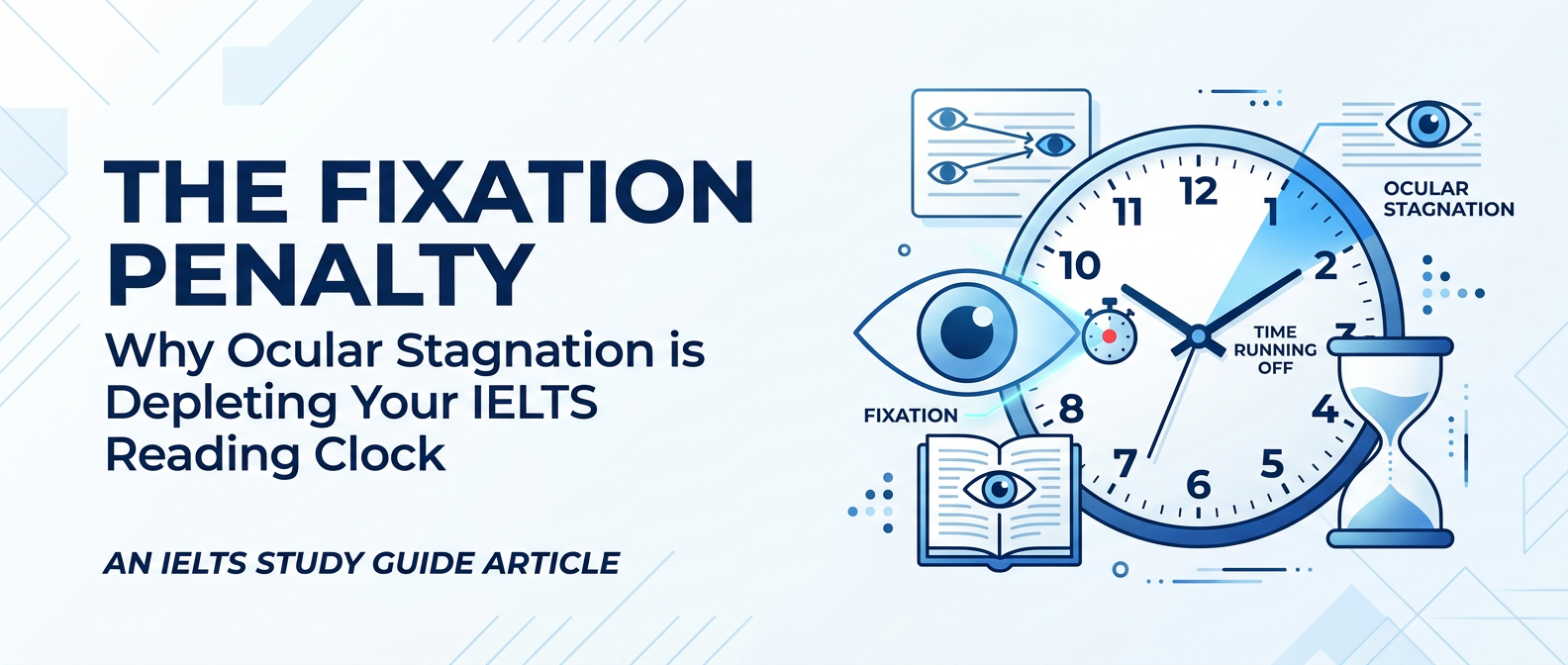
The Fixation Penalty: Why Ocular Stagnation is Depleting Your IELTS Reading Clock
The ticking clock in the IELTS Reading room isn't just a measure of time; it is a measure of processing efficiency. While most candidates believe they run out of time because they are 'slow readers,' the reality is often rooted in a neurological phenomenon known as 'fixation duration.' Research suggests that while a skilled reader processes clusters of words in 200 milliseconds, a struggling candidate often fixates on a single unfamiliar word for up to 500 milliseconds, creating a cumulative time debt that is impossible to repay by Passage 3.
According to the [official IELTS band descriptors](https://www.ielts.org/for-researchers/band-descriptors), high-level achievement requires more than just vocabulary; it demands an ability to synthesize complex arguments at speed. If you find yourself with five questions left and only two minutes on the clock, you aren't suffering from a lack of English knowledge—you are suffering from 'The Fixation Penalty.'
The Psychology of the 'Re-Reading' Loop
Many candidates fall into the trap of the regression cycle. This occurs when your eyes move backward to re-read a sentence you didn't fully comprehend the first time. A study indexed on [Google Scholar](https://scholar.google.com/scholar?q=eye+tracking+reading+comprehension+L2+learners) confirms that second-language learners spend up to 15% of their reading time on 'regressive eye movements.'
In the context of the IELTS, this is fatal. Passage 3 often contains dense, academic prose. If you regress just twice per paragraph, you lose approximately 4 to 6 minutes across the entire test. This is where [Sub-skill analysis](https://www.ielts.org/for-test-takers/how-ielts-is-scored) becomes vital; understanding whether your weakness lies in 'Skimming for Gist' or 'Scanning for Specific Detail' allows you to target the exact moment your pacing breaks down.
The 'Search vs. Solve' Imbalance
One of the most unique insights into timing is the 'Search vs. Solve' ratio. Most students spend 80% of their time 'searching' for the answer in the text and only 20% 'solving' (analyzing the logic). To reach a Band 7.5+, you must flip this ratio.
To do this, you need to understand the 'Keyword Shadow.' Instead of looking for the exact word in the question, you must look for its conceptual shadow—synonyms and parallel expressions. As noted by [IELTS Advantage](https://www.ieltsadvantage.com), the test is essentially a giant vocabulary test wrapped in a reading test. If the question asks about 'environmental impact,' the text might discuss 'ecological footprints' or 'habitat degradation.'
The 17-20-23 Timing Blueprint
Ignore the advice to spend 20 minutes on each passage. The passages increase in lexical complexity. Use this calibrated breakdown instead:
> Quick Tip: Never read the whole passage first. Read the first set of questions to 'prime' your brain, then 'anchor' yourself by finding names, dates, or capitalized nouns that act as geographical landmarks in the text.
The Semantic Priming Technique
To avoid 'The Fixation Penalty,' use a technique called Semantic Priming. This involves looking at the title and subheadings and spending exactly 30 seconds predicting the 'lexical field' (the group of words related to that topic).
For example, if the title is 'The Migration of Arctic Tern,' your brain should immediately 'load' words like navigation, breeding, climate, plumage, and predators. This reduces the 'start-up' time your brain needs when it encounters these words in the text. This isn't just a strategy; it's a cognitive shortcut endorsed by [Cambridge English](https://www.cambridgeenglish.org/exams-and-tests/ielts/) to help learners handle 'unfamiliar' topics.
Common Mistakes: The 'Scanning Blind Spot'
Many candidates believe scanning means looking for a word. It actually means looking for the shape of an answer.
* Mistake 1: The Literal Search. Looking for '19th century' but missing 'the 1800s.'
* Mistake 2: Reading for Pleasure. Treating the text like a novel. You are a 'data retriever,' not a reader.
* Mistake 3: The Order Trap. Not all questions follow the order of the text (e.g., 'Matching Information' or 'Matching Headings').
According to research published on [ResearchGate](https://www.researchgate.net/search/publications?q=IELTS+Reading+strategies), students who fail to distinguish between 'ordered' and 'unordered' question types lose an average of 4 minutes just flipping pages back and forth.
How to Build 'Ocular Stamina'
If you want to stop running out of time, you need a personalized [AI Roadmap](https://takeielts.britishcouncil.org/teach-ielts/resources) that identifies which question types trigger your 'regression' habit. Perhaps you are fast at 'Multiple Choice' but freeze during 'True, False, Not Given.'
Using tools like Reading Pro or the Growth Engine, you can simulate the pressure of the 60-minute limit while receiving a real-time Band Prediction. This data reveals if your timing issues are linguistic (you don't know the words) or strategic (you're spending too long on one question).
Step-by-Step Recovery Method: The 'Stop-and-Skip' Rule
The Role of 'Automaticity'
A significant portion of IELTS success relies on 'automaticity'—the ability to perform a task without conscious thought. As the [British Council](https://takeielts.britishcouncil.org/teach-ielts/resources) resources suggest, the more you expose yourself to academic registers from sources like the [BBC Learning English](https://www.bbc.co.uk/learningenglish), the more 'automatic' your recognition of complex grammar becomes. When grammar becomes automatic, your cognitive energy is freed up to focus on the clock.
Summary of the High-Efficiency Workflow
| Stage | Action | Time Spent |
| :--- | :--- | :--- |
| The Prime | Read Title/Subheads & Predict Vocab | 30 Seconds |
| The Probe | Read Question 1-4 & Identify 'Anchors' | 60 Seconds |
| The Retrieval | Scan for Anchors and Solve | 15-18 Minutes |
| The Exit | Final Guess on 'Skipped' Items | 1 Minute |
Takeaway
You aren't running out of time because the test is too long; you are running out of time because your brain is over-processing low-value information. By implementing the 'Stop-and-Skip' rule and utilizing [Sub-skill analysis](https://www.ielts.org/for-test-takers/how-ielts-is-scored) to diagnose your specific fixation triggers, you can reclaim the 10 minutes you usually lose to 'the regression loop.' Efficiency in IELTS Reading is not about reading faster; it is about deciding what not to read.