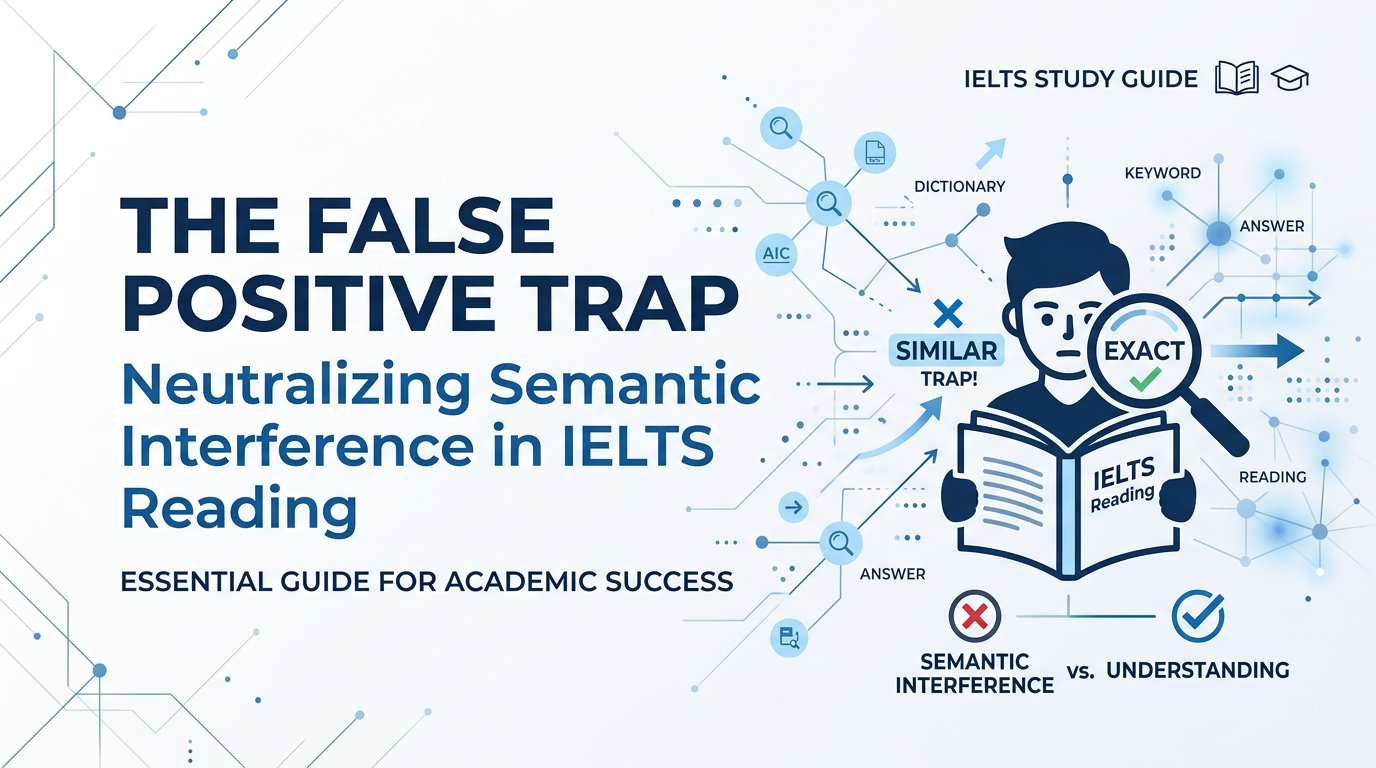
The False Positive Trap: Neutralizing Semantic Interference in IELTS Reading
The Psychological Illusion of the 'Near-Match'
Imagine reading a sentence about a scientific discovery and feeling a jolt of recognition. You see the word 'significant,' and the question asks if the results were 'important.' You immediately tick 'True.' However, you just fell for a semantic trap. According to the [official IELTS band descriptors](https://www.ielts.org/for-researchers/band-descriptors), high-level reading performance requires distinguishing between explicit information and implied intention, a nuance where many Band 6.0 candidates falter.
A fascinating study on [cognitive bias in language testing](https://scholar.google.com/scholar?q=cognitive+bias+in+IELTS+reading+comprehension) suggests that test-takers often subconsciously prioritize 'lexical overlap' (matching words) over 'propositional logic' (matching meaning). This is the breeding ground for the 'False Positive'—the moment you choose 'True' simply because the vocabulary looks familiar, even though the logical relationship is non-existent.
Decrypting the 'Not Given' Ghost
The 'Not Given' option is arguably the most psychologically taxing element of the Reading module. Candidates often treat it as a failure of their own searching ability rather than a valid answer. Research published via [Cambridge English](https://www.cambridgeenglish.org/exams-and-tests/ielts/) emphasizes that IELTS tasks are designed to test your ability to recognize the boundaries of provided information.
The Three Types of Trap Logic
> Quick Tip: If you find yourself searching for a single sentence for more than 90 seconds, you are likely chasing a 'Not Given' ghost. Use your AI Roadmap to track how long you spend on these specific question types during practice to identify your 'frustration threshold.'
The 'Polarity Check' Technique
To move beyond Band 6.5, you must stop looking for words and start looking for contradictions. The [British Council](https://takeielts.britishcouncil.org/teach-ielts/resources) recommends a systematic approach to verifying a 'False' answer versus a 'Not Given' one. Use this 3-step method:
This level of sub-skill analysis—isolating logical links from lexical matches—is what differentiates a Band 7.0 reader from the rest. The [Growth Engine](https://ieltsliz.com) approach often highlights that 'False' requires a direct contradiction, whereas 'Not Given' is simply a lack of evidence.
An Anatomy of a Trap
Let’s look at a concrete example derived from official [Cambridge ELT](https://www.cambridge.org/elt) practice materials:
* Text: "While the architecture of the 1920s was experimental, it failed to gain widespread popularity among the working class due to the high cost of materials."
* Question: "The working class disliked the aesthetic style of 1920s architecture."
The Trap: Candidates see 'working class' and 'failed to gain popularity' and immediately choose True.
The Reality: The text cites cost as the reason for the lack of popularity, not aesthetics. The working class might have loved the style but couldn't afford it. The correct answer is Not Given.
Overcoming the 'Probability Bias'
Many students use their general knowledge to answer questions, a habit that the [University of Oxford’s linguistics research](https://en.wikipedia.org/wiki/International_English_Language_Testing_System) warns against. You might know that global warming is causing sea levels to rise, but if the text focuses exclusively on melting glaciers without mentioning sea levels, you must mark it 'Not Given.'
Frequent use of an AI Speaking Examiner or Writing Pro can actually help here, as it trains you to produce and recognize structured evidence-based arguments, rather than relying on external assumptions.
Common Mistakes to Avoid
* Matching Adjectives Only: Just because the text says "The weather was cold" and the question says "The weather was frigid" doesn't make it a guaranteed match. Check the scope of the adjective.
* Ignoring Quantifiers: Words like 'all', 'some', 'many', and 'only' are the most common tools for setting traps. According to [TESOL resources](https://tesol.org), these function as logical operators that fundamentally change the truth value of a statement.
* Over-reading: Adding your own inferences. If the text says "A is higher than B," do not assume "B is too low."
The Path to Precision
Accuracy in True/False/Not Given isn't about knowing more words; it’s about understanding the 'logical delta'—the gap between what is said and what is inferred. By training your brain to hunt for contradictions rather than confirmations, you bypass the psychological traps set by test designers.
To see how your logical accuracy stacks up, consult your Band Prediction after a full-length mock. If your 'Not Given' accuracy is below 60%, it's time to shift your focus from vocabulary lists to propositional logic drills. The difference between a 6.5 and a 7.5 isn't found in a dictionary; it’s found in the restraint to not assume information that isn't there.