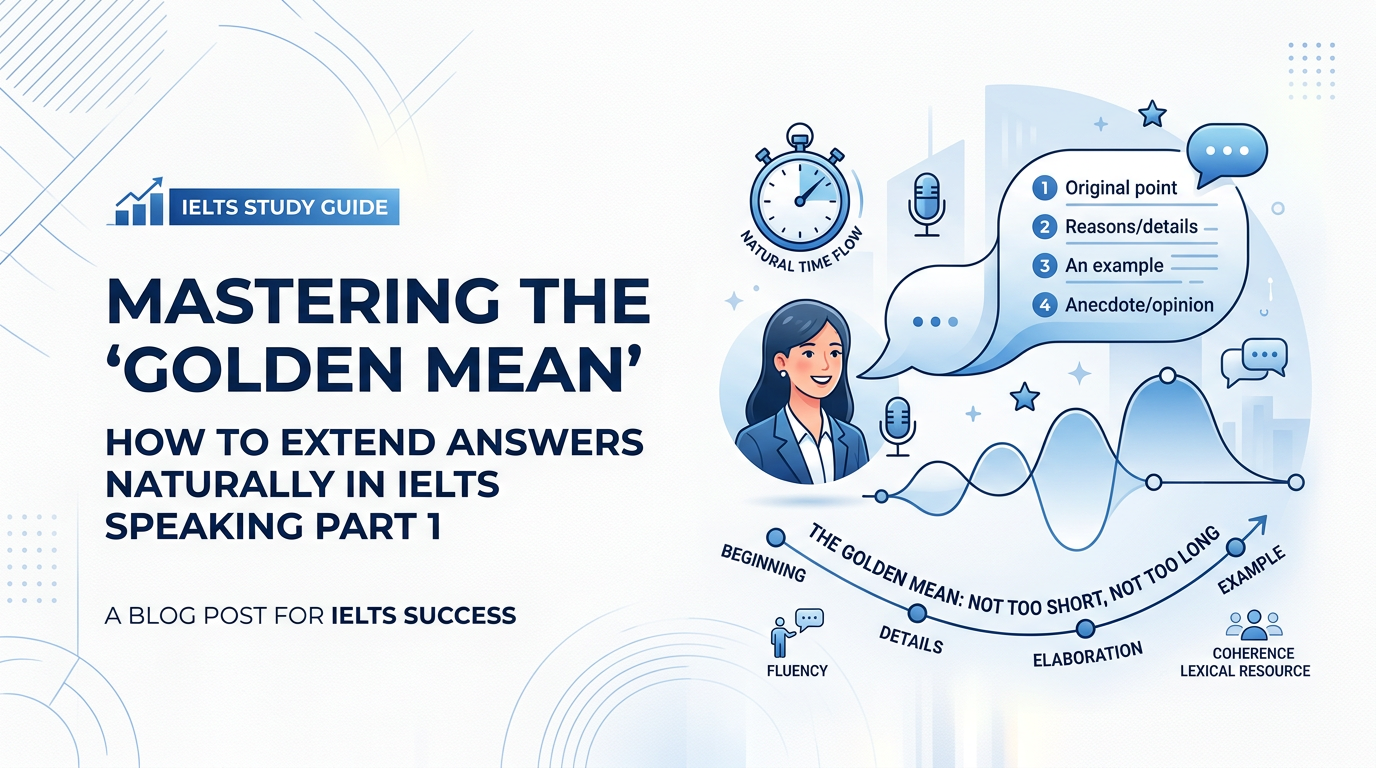
Mastering the 'Golden Mean': How to Extend Answers Naturally in IELTS Speaking Part 1
The Part 1 Dilemma: Too Short or Too Long?
In IELTS Speaking Part 1, many candidates fall into one of two traps. They either give 'robotic' one-word answers (Examiner: "Do you like cooking?" Candidate: "Yes, I do.") or they treat it like a long-form presentation, speaking until the examiner has to awkwardly interrupt them.
To hit that Band 7.0+ territory, you need to find the 'Golden Mean.' You should aim for 2–4 sentences that feel natural, conversational, and demonstrate a range of vocabulary. Here is how you can transform your responses from simple to sophisticated.
1. The 'REDS' Formula for Natural Extension
When you are nervous, your brain often freezes. Having a mental framework helps you extend your answer without overthinking. We recommend the REDS method:
* R - Reason: Why do you feel that way?
* E - Example: Give a specific instance.
* D - Detail: Add a descriptive adjective or a frequency adverb.
* S - Speculation: Talk about the future or a hypothetical situation.
Example Question: "Do you prefer relaxing at home or going out?"
* Basic Answer: "I prefer staying at home because it is comfortable."
* REDS Extended Answer: "I definitely prefer staying at home, mostly because I’m a bit of an introvert (Reason). For instance, last weekend I just stayed in and read a novel instead of hitting the town (Example). It’s just much more peaceful than a noisy club (Detail)."
To see if you are applying these structures correctly, you can use our Speaking practice module. The AI provides Sub-skill analysis, scoring you on over 12 different metrics including coherence and grammatical range, so you can see exactly where your extensions might be falling flat.
2. Using Dependent Prepositions and Relative Clauses
One of the easiest ways to extend a sentence naturally is to use 'which' or 'where' to add extra information. This moves you away from simple sentences toward complex structures—a key requirement for higher band scores.
* Instead of: "I live in Hanoi. It is a busy city."
* Try: "I live in Hanoi, which is the bustling capital of Vietnam and is famous for its incredible street food."
Using these connectors naturally can be difficult to master alone. This is where your AI Roadmap comes in. If the AI detects that your sentence structures are too repetitive, it will adjust your Growth Engine daily tasks to include specific exercises on complex sentence building.
3. The 'Opposite' Technique
If you can’t think of more to say about your choice, talk about the alternative. This is a very natural way that native speakers communicate.
Question: "Do you like wearing bright colors?"
Answer: "Actually, not really. I usually stick to neutral tones like black or navy. While some people love standing out in neon yellow or pink, I personally feel a bit self-conscious in anything too flashy."
By mentioning what you don't like or what other people do, you've doubled the length of your answer while showing off your ability to use contrast markers like 'while' or 'whereas.'
Common Mistakes to Avoid
The 'Over-Explainer'
Don't spend two minutes talking about your favorite color. Part 1 is supposed to be a warm-up. If you talk too much here, you'll feel exhausted by the time you reach the more difficult Part 3. Aim for 20–30 seconds per answer.
The 'Parrot'
Avoid repeating the examiner's question word-for-word.
* Examiner: "Is watching sports popular in your country?"
* Mistake: "Yes, watching sports is very popular in my country."
* Better: "Absolutely, people in my homeland are obsessed with football, especially when the national team is playing."
How to Track Your Progress
Knowing if you are improving is the hardest part of self-study. You might feel like you are speaking more, but are you actually hitting the descriptors for a Band 7.0?
Our platform’s Band Prediction feature uses advanced speech recognition to give you a real-time estimate of your current level. By analyzing your recording, the system provides a breakdown through Sub-skill analysis, telling you if your 'Fluency and Coherence' score is being dragged down by too many 'ums' and 'ahs' or if your 'Lexical Resource' is varied enough for a high mark.
Practical Exercise for Today
If you want a more structured approach, let our Growth Engine handle it. It identifies your weakest sub-skills and serves you daily micro-tasks—like a 2-minute speaking drill or a vocabulary challenge—to ensure you never plateau.
Mastering Part 1 is about confidence and habit. Once you get used to extending your answers naturally, the rest of the speaking test feels much less intimidating. Happy practicing!