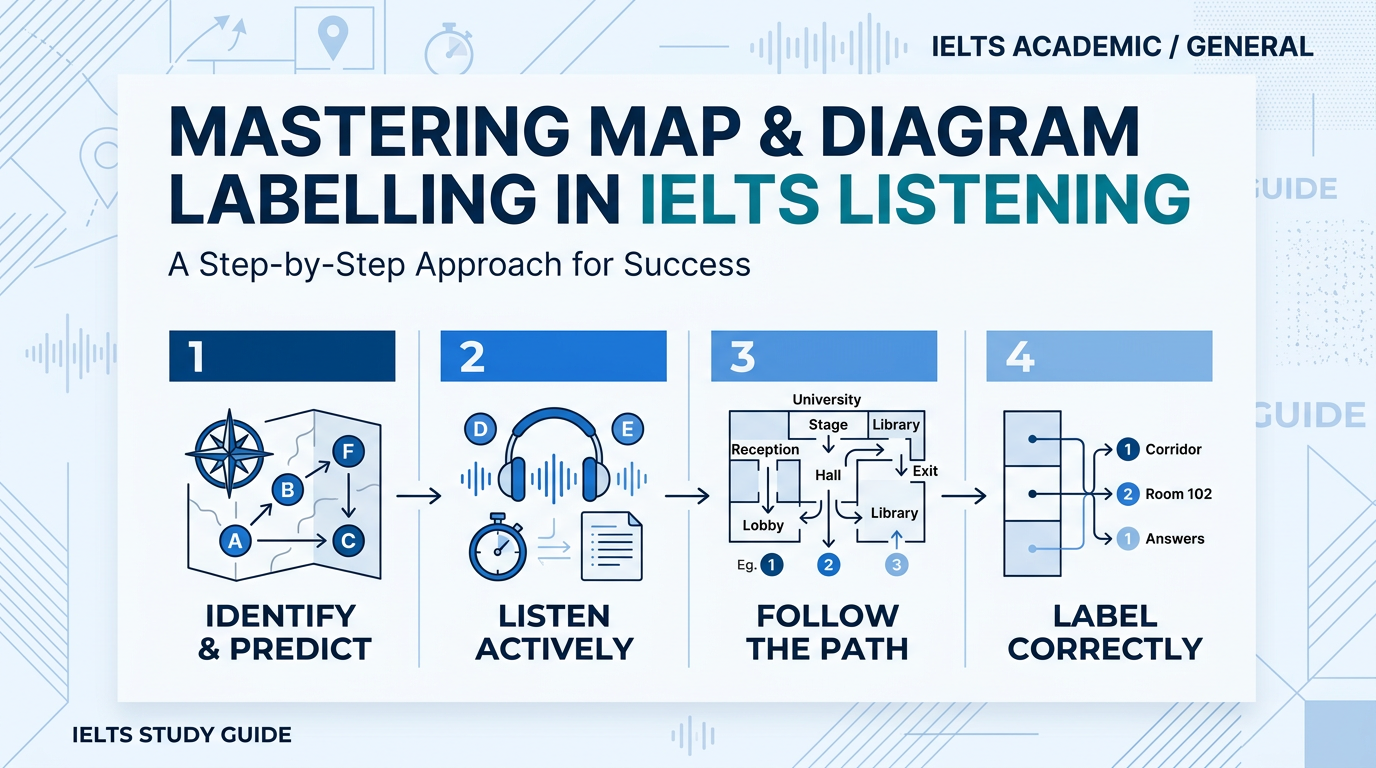
Mastering Map and Diagram Labelling in IELTS Listening: A Step-by-Step Approach
Introduction
For many IELTS candidates, map and diagram labelling tasks in the Listening module feel like a high-speed chase. You are trying to find a building or a lever on a drawing while a speaker talks at a steady pace, often using complex directional language. If you miss one turn, you might lose the next three answers.
Whether it’s a site map of a festival in Section 2 or a technical diagram of a solar panel in Section 4, success requires more than just good hearing—it requires spatial awareness and a solid strategy. In this guide, we will break down the exact steps to handle these questions with confidence.
Understanding the Challenge
In Map and Diagram tasks, you are usually given a visual and a list of labels (either as multiple-choice options or gaps to fill with words from the recording). The challenge is twofold:
If you find your scores fluctuating in this area, our Sub-skill analysis feature can help. It tracks your performance across 12+ specific listening skills, identifying exactly if your weakness lies in "spatial orientation" or "identifying technical vocabulary."
Step 1: The 'Golden 30 Seconds' (Preparation)
Before the audio begins, you have a short window of time. Move your eyes across the map/diagram and do the following:
* Find the Starting Point: Most maps have a clear entrance or a "you are here" marker. If they don’t, look for the main gate or the bottom center of the page. This is where the speaker will likely begin.
* Identify the 'Anchors': Look for features that are already labeled (e.g., "Library," "Reception," or "Piston A"). These are your landmarks. When the speaker mentions an anchor, you know exactly where they are on the page.
* Check the Compass/Directions: Is there a North-South-East-West compass? If so, expect directional language. If not, expect relative language like "on the left," "at the top," or "in the far corner."
Step 2: Predicting the Path
While looking at the question numbers (e.g., 11, 12, 13), notice their sequence. In IELTS, the answers always follow the order of the audio. If Question 11 is at the top of the map and Question 12 is at the bottom, the speaker will travel from top to bottom.
Our AI Roadmap often highlights this "sequential tracking" as a core skill. If you struggle to keep up, your personalized study plan will suggest specific drills in the Listening Pro module to improve your scanning speed.
Step 3: Listen for Transition Markers
Speakers use specific signposting language to move you through the visual. Watch out for:
* Prepositions of place: "Beyond the gym," "opposite the cafe," "halfway along the path."
* Movement verbs: "Turn sharp right," "carry on past," "veer left."
* Order indicators: "Before you get to...", "The first thing you’ll see is..."
Common Mistake: Don't just listen for the names of the labels. Listen for the relationship between the labels and the landmarks. For example, if the speaker says, "The staff room is tucked away behind the toilets," and you only hear "toilets," you might pick the wrong letter.
Step 4: The 'Pen-on-Paper' Technique
During the test, keep your pencil on the map. Move your pencil as the speaker describes the route. This physical connection between your hand and the visual prevents you from getting lost. If the speaker says "Go through the double doors and walk to the end of the corridor," your pencil should be moving through the doors and down that corridor in real-time.
Common Pitfalls to Avoid
How to Improve Consistently
Mastering maps isn't a one-day task. It requires repetitive exposure to different layouts. This is where the Growth Engine becomes your best friend. It analyzes your daily practice and, if it detects you are missing map questions, it will serve you specific map-labelling tasks the next day to turn that weakness into a strength.
As you practice with our Listening Pro module, you'll see your Band Prediction update in real-time. Seeing that score climb from a 6.0 to a 7.5 provides the motivation needed to stay consistent.
Action Plan for Your Next Practice Session
By following this structured approach, maps and diagrams will stop being a source of anxiety and start being a source of easy points. Ready to see where you stand? Take a practice test today and check your Sub-skill analysis to see if you're a map master!