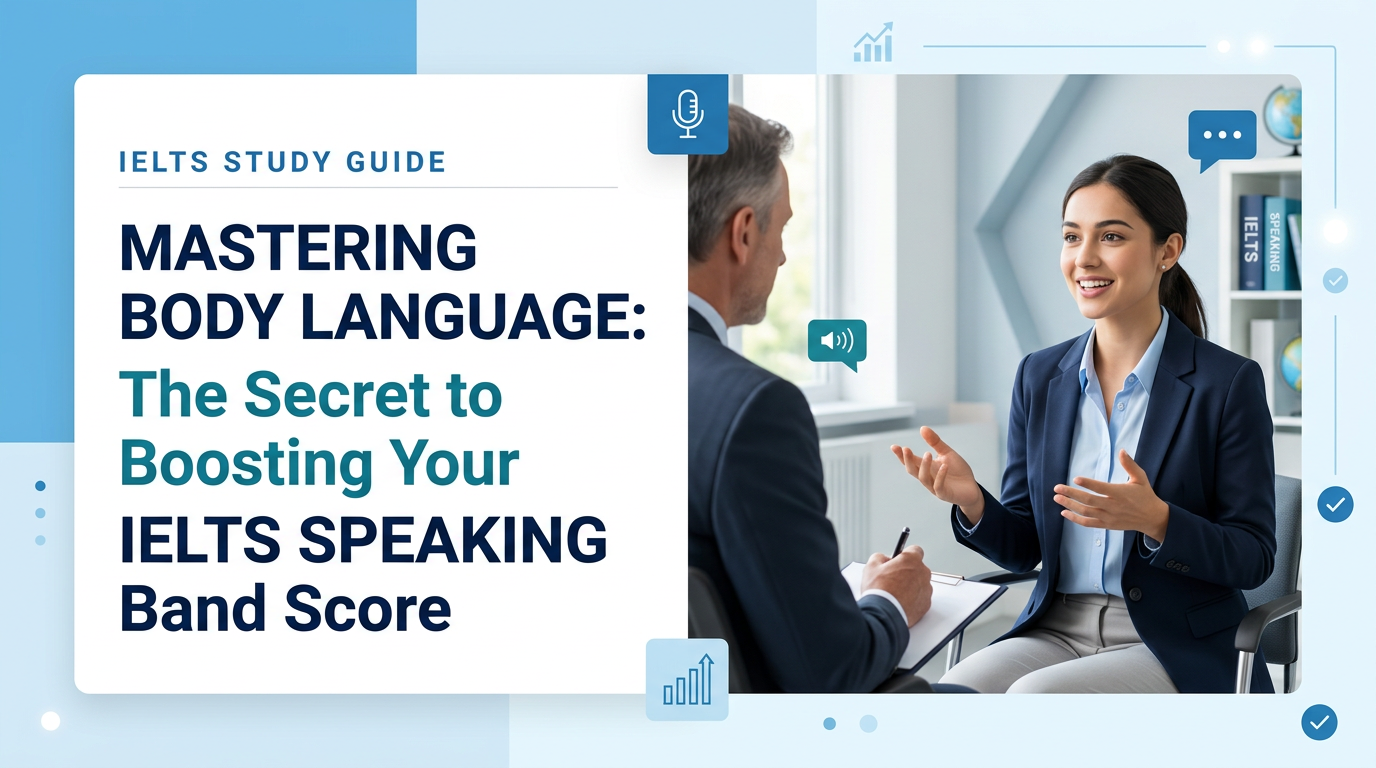
Mastering Body Language: The Secret to Boosting Your IELTS Speaking Band Score
Why Body Language Matters in a Speaking Test
When preparing for the IELTS Speaking test, most candidates focus entirely on grammar, vocabulary, and pronunciation. While these are the pillars of your score, there is a "hidden" element that often dictates how well you perform: body language.
Even though the examiner doesn't give you a specific grade for "movement," your body language directly influences your Fluency and Coherence. If you are stiff, nervous, or avoiding eye contact, your brain is under high stress, which leads to more hesitations, 'ums', and 'errs'.
In this guide, we will explore how to use your body to project confidence, improve your flow, and ultimately achieve a higher band score.
1. The Power of Eye Contact
In many cultures, staring can feel aggressive, but in the IELTS Speaking test, eye contact is a tool for connection.
* The Goal: Maintain natural eye contact about 60-70% of the time. This shows the examiner you are engaged and confident in your ideas.
* The Mistake: Looking at the floor, the ceiling, or your notes in Part 2 for too long. This makes it look like you are searching for words or memorizing a script.
* The Tip: Imagine you are talking to a respected colleague or a teacher. If you find direct eye contact difficult, try looking at the examiner's forehead or the space between their eyes.
2. Using Hand Gestures to Fuel Fluency
Did you know that using your hands can actually help you find words faster? Scientific research shows that hand gestures are linked to the language centers of the brain.
* The Goal: Use your hands to emphasize points. For example, use your fingers to list items ("First... second...") or move your hands apart to show a large scale.
* The Mistake: Keeping your hands tucked under the table or sitting on them. This creates tension in your shoulders and throat, which can make your voice sound strained.
* The Tip: Keep your hands above the table and open. Open palms generally signal honesty and openness, which helps build rapport with the examiner.
3. Posture and Breathing
Your physical stance affects your oxygen intake and your vocal projection. If you slouch, you compress your lungs, making it harder to speak in long, complex sentences.
* The Goal: Sit upright but not rigid. Lean slightly forward when you are making an important point to show enthusiasm.
* The Mistake: Slumping back into the chair, which can make you appear disinterested or overly casual.
* The Tip: Before you enter the exam room, try a "power pose"—stand tall with your hands on your hips for 30 seconds. This lowers cortisol (the stress hormone) and boosts confidence.
4. Turning Anxiety into Energy
It is normal to feel nervous. Many candidates try to hide their nerves by staying perfectly still, but this often backfires and makes them look robotic.
Instead of fighting the nerves, use that energy. Smile when you talk about something you enjoy in Part 1. Use facial expressions to show your opinion—raise your eyebrows if you are talking about something surprising.
If you find that your nerves are consistently affecting your performance, it might be time for more structured practice. Our Speaking practice module allows you to record your answers in a simulated environment, helping you get used to the pressure of the clock.
5. Bridging the Gap Between Body and Speech
Body language is the "wrapper" for your English skills. However, if your underlying language skills aren't sharp, even the best posture won't save a Band 5.5 response.
To see how your physical confidence translates into data, use our Sub-skill analysis. We analyze over 12 different sub-skills for every response you record. You might find that when you focus on your posture, your "Hedge Words" or "Pacing" sub-scores actually improve because you are more relaxed.
How to Practice at Home
Conclusion
The IELTS Speaking test is a communication test, not just a grammar test. By using natural eye contact, open hand gestures, and a strong posture, you signal to the examiner that you are a proficient user of English.
Combine these non-verbal tips with our Band Prediction tool to see how your improvements are moving the needle. When you see your predicted score climb from a 6.0 to a 7.0, your natural confidence—and your body language—will follow suit.
Ready to see where you stand? Head over to our Speaking practice module today and get your first real-time Band Prediction!