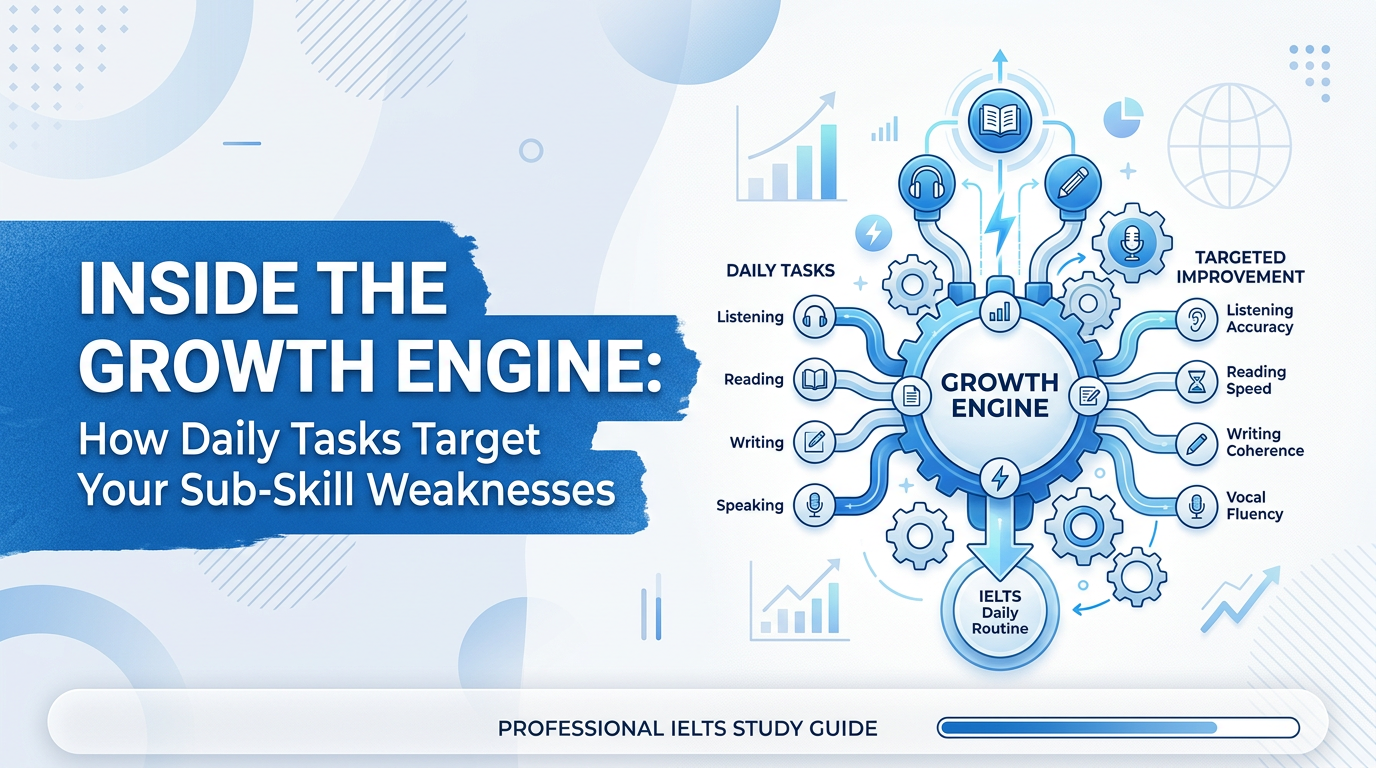
Inside the Growth Engine: How Daily Tasks Target Your Sub-Skill Weaknesses
Why does a candidate with a near-perfect grasp of English grammar often stall at a Band 6.5 in Writing? The answer isn't a lack of effort; it is a lack of granularity. Most IELTS preparation is 'macro-focused'—students take full practice tests, see a score, and try again. However, research into [educational measurement and evaluation](https://www.cambridgeenglish.org/exams-and-tests/ielts/) suggests that high-stakes testing success is determined not by total volume of study, but by the surgical isolation of sub-skills.
Traditional methods treat the four components of IELTS as monoliths. In reality, according to the [official IELTS band descriptors](https://www.ielts.org/for-researchers/band-descriptors), each module is a complex composite of at least 12 distinct sub-skills. If you are struggling with Writing Task 2, the problem might not be 'Writing'; it might be 'Logical Cohesion' or 'Lexical Precision in Abstract Contexts.' This is where the Growth Engine shifts the focus from broad practice to algorithmic calibration.
The Science of Micro-Granularity
When you engage with the Growth Engine’s daily tasks, you aren't just 'practicing English.' You are feeding data into a system that monitors your Sub-skill Analysis. For example, in Reading, many students fail to distinguish between 'Not Given' and 'False' because of a specific cognitive gap in 'Inference of Authorial Intent.'
A study indexed on [Google Scholar focusing on L2 reading comprehension](https://scholar.google.com/scholar?q=L2+reading+comprehension+sub-skills+IELTS) highlights that 'local' processing (understanding words) and 'global' processing (understanding discourse) are two different neurological paths. If your Reading Pro tasks identify that you move too slowly through factual passages, the engine doesn't just give you more reading; it pivots your AI Roadmap to focus on scanning for specific nomenclature.
How Daily Tasks Dismantle the 'Plateau'
The 'Band 6.5 Plateau' is often the result of fossilized errors—mistakes that have become so habitual they feel correct. To break this, the Growth Engine utilizes a 'Daily Task' architecture that forces the brain into a state of 'productive struggle.'
> Quick Tip: The 10% Volatility Rule
> Your score will naturally fluctuate by 0.5 bands based on topic familiarity. To stabilize your score, use Writing Pro to practice 'low-interest' topics (like 'Space Exploration' or 'Urban Planning') specifically to build lexical flexibility where you lack personal interest.
Beyond Words: Engineering 'Prosodic Features'
One of the most overlooked aspects of the Speaking module is prosody—the rhythm and intonation of your speech. According to [Wikipedia’s technical breakdown of IELTS](https://en.wikipedia.org/wiki/International_English_Language_Testing_System), 'Pronunciation' accounts for 25% of the Speaking score. Most students think this means 'accent,' but examiners actually look for 'chunking' and 'stress-timing.'
If the engine detects that your speech is 'staccato' (every word has equal weight), your daily tasks will shift. You might be asked to shadow a model answer from [BBC Learning English](https://www.bbc.co.uk/learningenglish) to recalibrate your internal metronome. This is the difference between a Band 6.0 ('speech is often characterized by pauses') and a Band 7.0 ('produces error-free sentences with only occasional inaccuracies').
The Geometry of Task 2: A Logic Walkthrough
Consider this prompt: "Some people think that the best way to reduce crime is to give longer prison sentences."
* Candidate A (The Generalist): Writes a long essay about how crime is bad and prisons are crowded. (Likely Band 6.0 for 'Task Response').
* Candidate B (The Engine-Trained): Analyzes the prompt through the lens of 'Cohesion and Coherence.' They use a 'Specific-to-General' logical flow.
Example Sentence Calibration:
Weak:* "If people go to jail for a long time, they will be scared to commit crimes."
Engine Optimized:* "Extended carceral sentences may serve as a deterrent; however, longitudinal data suggests that recidivism rates are more effectively lowered through vocational rehabilitation."
By using the Writing Pro feedback loop, the engine identifies that Candidate B's strength is vocabulary but their weakness is 'Referencing.' It will then generate tasks specifically on using anaphoric references (e.g., this trend, such measures) to link ideas without repetition.
Common Mistakes to Avoid in Daily Practice
* The Content Trap: Spending hours reading news articles without checking how they align with [IELTS-specific scoring criteria](https://www.ielts.org/for-test-takers/how-ielts-is-scored).
* Ignoring the Clock: Practicing without a temporal constraint. The Growth Engine's tasks are timed to simulate the 'Cognitive Load' of the actual exam.
* Over-reliance on 'Big Words': Experts like [IELTS Liz](https://ieltsliz.com) frequently emphasize that using high-level words incorrectly is worse than using simple words correctly. The engine’s Sub-skill Analysis flags 'Lexical Over-extension'—when you use a word like 'plethora' in the wrong context.
The Data-Driven Advantage
Ultimately, the path to a Band 8.0 is not paved with more textbooks; it is paved with data. By analyzing your performance across 12+ sub-skills, the Growth Engine builds a profile of your 'Linguistic Thumbprint.' It knows if your Listening Pro scores drop during 'Section 4' (academic lectures) versus 'Section 1' (transactional dialogue), and it adapts accordingly.
As noted in the [IELTS Advantage research on task achievement](https://www.ieltsadvantage.com), the difference between 6.5 and 7.5 is rarely 'knowing more English'—it is 'knowing how to apply it' under the specific constraints of the test.
Final Takeaway: Stop treating your prep like a marathon and start treating it like a series of high-intensity interval sprints. Use the AI Roadmap to find the 20% of your weaknesses that are causing 80% of your score stagnation. When the tasks get harder, that is the engine finding the edge of your capability—and pushing past it.