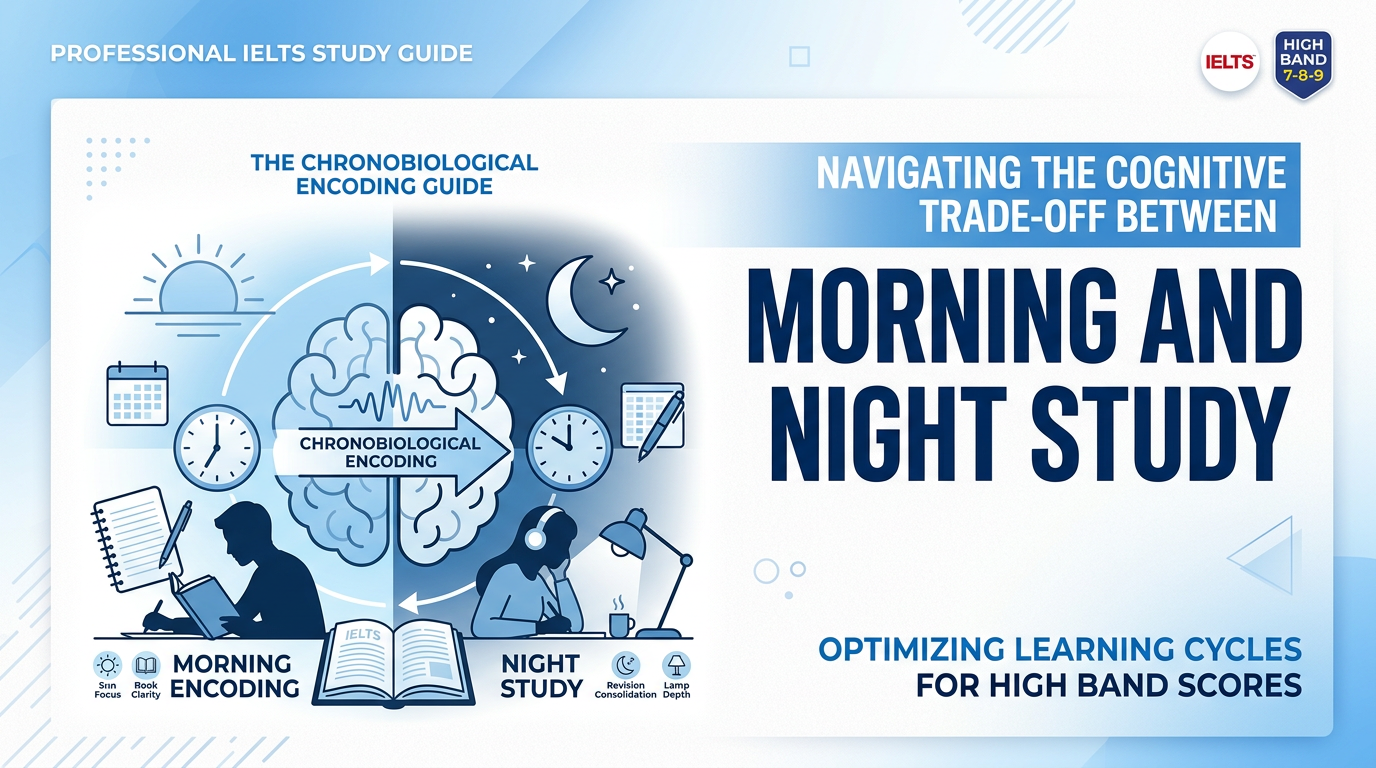
Chronobiological Encoding: Navigating the Cognitive Trade-off Between Morning and Night Study
Does your brain process the passive voice differently at 7:00 AM than it does at 9:00 PM? While most candidates obsess over the quantity of practice tests, few consider the biological window of acquisition. Recent neuroscientific insights suggest that your internal clock—your circadian rhythm—determines not just when you are awake, but how efficiently your brain encodes the complex semantic relationships required for a Band 8.0.
For an IELTS candidate, the choice between being an 'early bird' or a 'night owl' isn't just a lifestyle preference. It is a strategic decision that affects your ability to distinguish between a distractor and a key supporting detail in the Reading section.
The Morning Surge: Semantic Precision and Speed
Research published on [ResearchGate](https://www.researchgate.net) suggests that cognitive performance in tasks requiring logical reasoning and speed peaks in the morning hours for most adults. This makes the morning the optimal time for IELTS Reading and Listening practice.
In the morning, the brain’s executive function is at its highest. When you are tackling a 'Matching Headings' task, you aren't just reading words; you are performing a high-level cognitive sort. A study indexed on [Google Scholar](https://scholar.google.com/scholar?q=circadian+rhythms+and+cognitive+performance+language+learning) indicates that short-term memory and processing speed are significantly more robust during the first four hours after waking.
Example: The 8:00 AM Reading Sprint
If you use an [AI Roadmap](https://www.google.com) to target your weaknesses, try scheduling your Reading Pro sessions before breakfast. Your brain's ability to ignore irrelevant data (the 'noise' in a passage about sub-aquatic archaeology) is significantly sharper. For instance, identifying the subtle difference between 'the majority' and 'a significant minority' requires a level of attention that often wanes as decision fatigue sets in by late afternoon.
The Evening Shift: Creative Fluency and Consolidation
Conversely, the evening offers a unique advantage for the productive skills: Writing and Speaking. While logical speed might decline, 'divergent thinking'—the ability to find creative solutions and varied vocabulary—often spikes in the late afternoon and early evening.
According to the [British Council's guidance on preparation](https://www.britishcouncil.org/exam/ielts/prepare-test), consistency is key; however, tying that consistency to the brain's natural relaxation phase can yield better results for Task 2 essays. When the mind is slightly less 'guarded' by the rigid logic of the morning, it becomes easier to access a wider lexical range. This is where you move beyond 'good' and 'bad' and start using terms like 'formidable' or 'detrimental'.
Furthermore, the 'Sleep-Dependent Memory Consolidation' theory suggests that information learned shortly before sleep is more likely to be converted into long-term memory. If you are struggling with [sub-skill analysis](https://www.google.com) results that show a weakness in 'Lexical Resource', studying high-level collocations at 9:00 PM might actually be more effective than at 9:00 AM.
> Quick Tip: The 20-Minute Pre-Sleep Review
> Instead of a full test, spend the 20 minutes before bed reviewing 10 'topic-specific' collocations (e.g., mitigating circumstances, environmental degradation, urban sprawl). Your brain will process these during REM sleep, making them more accessible for your next Speaking practice session.
The Data on Retention: A Surprising Statistic
Did you know that according to research cited in [Cambridge ELT journals](https://www.cambridge.org/elt), learners who split their study into two distinct 'circadian blocks' retain up to 25% more vocabulary than those who study in one marathon session? This 'spacing effect' is amplified when the morning session focuses on recognition (Reading/Listening) and the evening focuses on production (Writing/Speaking).
Engineering Your Day: A Step-by-Step Routine
To maximize your [Band Prediction](https://www.google.com) accuracy, you need a routine that aligns with your biology. Here is a scientifically backed 3ade-day structure for an IELTS candidate:
Common Mistakes: The 'Mid-Afternoon Slump' Trap
Many students attempt to do their hardest work—such as analyzing [official IELTS band descriptors](https://www.cambridgeenglish.org/exams-and-tests/ielts/gridding-and-marking/) for Writing Task 1—between 2:00 PM and 4:00 PM. This is often the 'post-prandial dip' where core body temperature drops and concentration plummets. Studying during this window often leads to frustration and the false belief that you aren't improving, when in reality, your brain is simply in a 'standby' mode.
Another error is the 'Midnight Grind.' While nighttime is good for vocab, staying up until 2:00 AM to finish a practice test is counterproductive. Sleep deprivation directly affects the prefrontal cortex, which is the exact area you need for the [Cambridge IELTS Reading tests](https://www.cambridge.org/gb/cambridgeenglish/catalog/cambridge-english-exams-ielts) which require intense focus on detail.
Final Takeaway: Find Your Chronotype
There is no 'gold standard' time that fits every human, but the data is clear: Input in the AM, Output in the PM. By aligning your hardest analytical tasks (Reading/Listening) with your morning surge and your creative, expansive tasks (Writing/Speaking) with your evening wind-down, you aren't just studying harder—you are studying with the grain of your own neurology.
Before your next session, ask yourself: Is my brain currently a calculator or a storyteller? Use the calculator for the morning's data and the storyteller for the evening's essays. This strategic pivot is often the difference between a plateau at 6.5 and a breakthrough to 7.5.