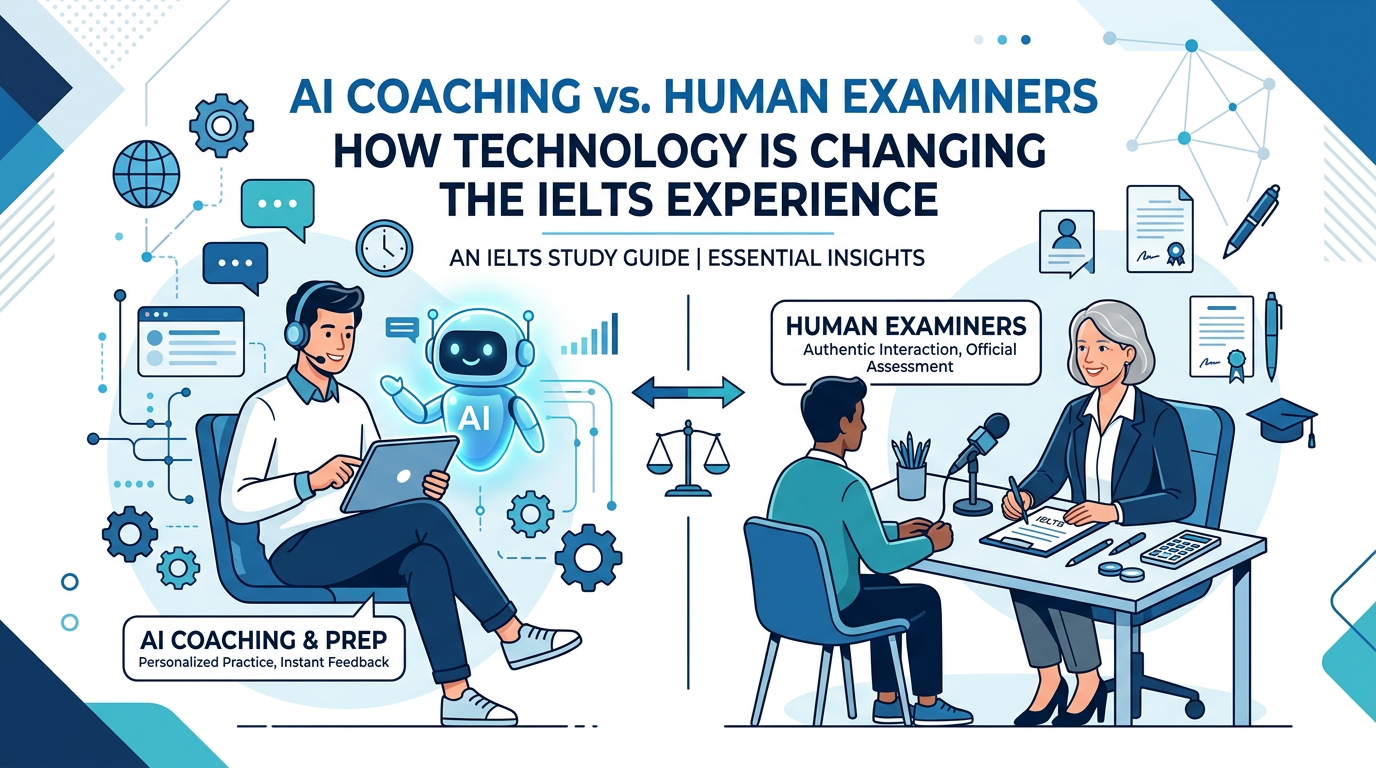
AI Coaching vs. Human Examiners: How Technology is Changing the IELTS Experience
Introduction: The New Frontier of IELTS Preparation
For decades, the path to a Band 7.0 or higher was paved with expensive private tutors and stacks of paper practice tests. However, the rise of Artificial Intelligence (AI) has fundamentally changed how candidates prepare for the IELTS. Many students now ask: "Can a machine really score my essay as well as a human examiner?"
Understanding the relationship between AI and human examiners is crucial for any candidate in the 5.5 to 7.0 range. While the final exam is still largely assessed by humans (or human-monitored systems), integrating AI into your preparation can be the difference between stagnating and soaring.
How Human Examiners Score Your Performance
IELTS examiners are highly trained professionals who follow a strict set of descriptors across four categories: Fluency and Coherence, Lexical Resource, Grammatical Range and Accuracy, and Pronunciation (for Speaking) or Task Response (for Writing).
Humans are excellent at understanding nuance, intent, and complex irony. They can tell when you are using a sophisticated idiom correctly in context versus when you have just memorized a phrase from a textbook. However, humans are also susceptible to fatigue and subjective bias. If an examiner has been grading essays for eight hours, their focus might slightly waver.
How AI Scoring Differs
AI doesn't get tired. It uses natural language processing (NLP) to compare your output against millions of data points from previous IELTS exams. Here is where the technology shines:
The Hybrid Approach: Why You Need Both
To succeed, you shouldn't choose one over the other. Instead, use AI to build the foundations so that you are "exam-ready" for the human rater.
For example, when using our Writing Pro module, the AI identifies repetitive vocabulary that a human examiner would penalize under 'Lexical Resource.' By fixing these patterns during your practice, you ensure that when a human finally reads your exam paper, they see a polished, diverse range of vocabulary.
Practical Tip: Don't "Robo-Speak"
One common mistake candidates make when practicing with AI is trying to sound like a computer to get a higher score. Remember, the AI is trained to reward natural high-level English. In the Speaking practice module, focus on natural intonation and pacing. If you speak like a robot, the sub-skill analysis will flag your 'Pronunciation' and 'Chunking' scores as low.
Bridging the Gap with a Personalized Strategy
The biggest challenge for Band 5.5 - 6.5 candidates is the "plateau." You know enough English to communicate, but you keep making the same small errors that prevent you from hitting Band 7.0.
This is where the AI Roadmap becomes your best friend. Instead of studying everything broadly, the roadmap creates a personalized study plan based on your specific performance data. If the AI detects that your 'Task Response' is weak in Writing Task 2, it will prioritize those lessons for you.
Furthermore, consistency is the enemy of failure. The Growth Engine provides daily tasks that target your identified weaknesses. If the system knows you struggle with 'Multiple Choice' questions in the Listening Pro or Reading Pro modules, it will feed you more of those specific question types until your accuracy improves.
Common Mistakes to Avoid in AI-Guided Practice
Ignoring the 'Why': Don't just look at your predicted band score. Read the sub-skill analysis to understand why* you got that score. Did you repeat the word "important" six times? Did you forget to use transition words?
* Over-reliance on Templates: AI (and human examiners) can spot a memorized template from a mile away. Use AI to develop your own voice, not to copy-paste someone else's.
* Neglecting the Time Limit: Even if you are practicing with high-tech tools, always use the timer. The pressure of the clock changes how you write and speak.
Conclusion: The Path to Band 7.0+
In the battle of AI vs. Human, the winner is the candidate who uses both. Use human examiners (through official practice tests) to understand the "feel" of the exam, but use AI to do the heavy lifting of daily improvement.
By leveraging tools like the AI Roadmap and Sub-skill analysis, you remove the guesswork from your preparation. You no longer have to wonder if you are improving; you can see it in your Band Prediction every single day.
Technology hasn't replaced the need for hard work, but it has certainly made the work a lot smarter. Start your journey today by focusing on your data, fixing your sub-skills, and turning your weaknesses into your greatest strengths.