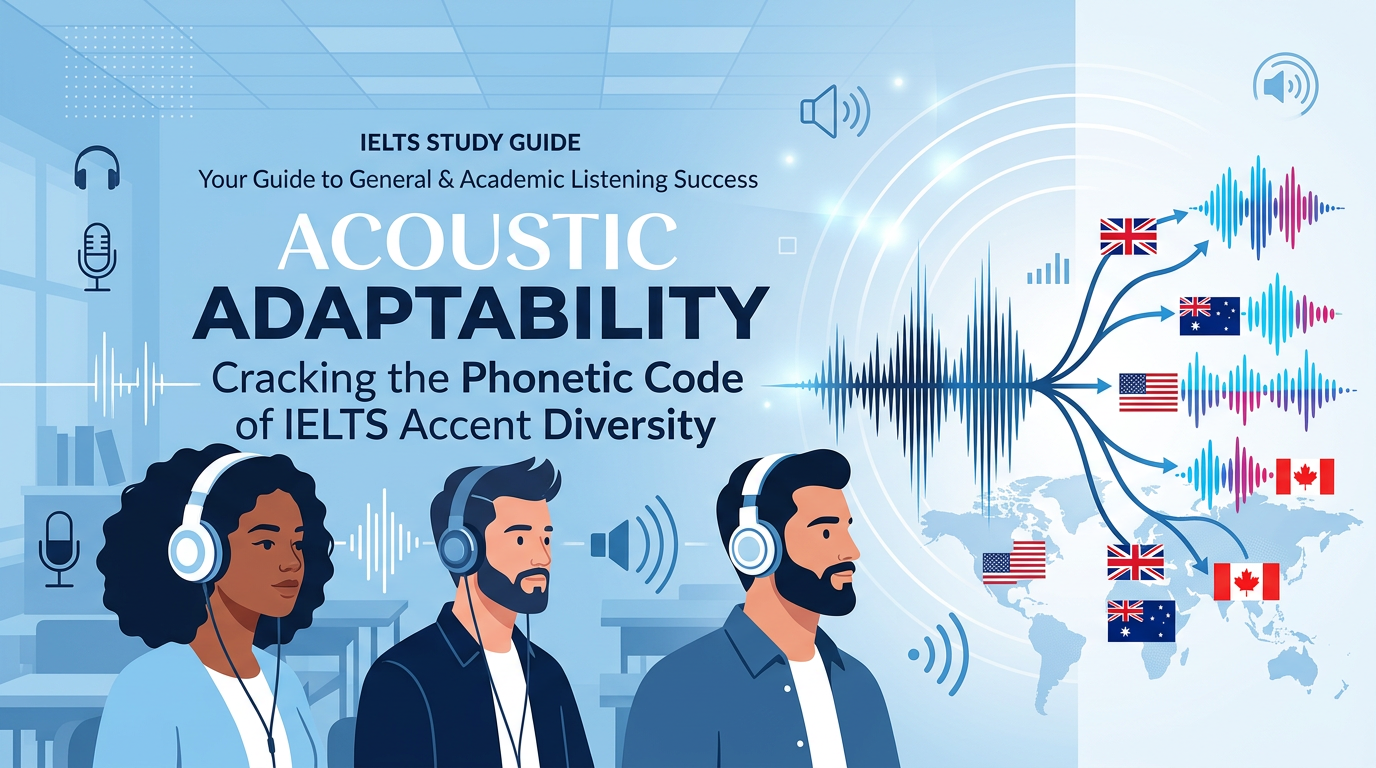
Acoustic Adaptability: Cracking the Phonetic Code of IELTS Accent Diversity
Imagine you have trained for six months on pure BBC English. You sit down for your IELTS Listening test, open the booklet, and press play. Suddenly, a speaker with a thick Australian drawl or a soft Scottish lilt begins discussing the irrigation systems of the Outback. Your brain freezes. This 'phonetic shock' is one of the most under-discussed reasons why high-level candidates fail to reach a Band 8.0.
While many test-takers focus on vocabulary, the real challenge lies in acoustic adaptability. According to the [official IELTS band descriptors](https://www.ielts.org/for-researchers/band-descriptors), high-level candidates must demonstrate the ability to follow complex arguments despite variations in speed and accent. The test is intentionally designed to reflect the global reality of English as a lingua franca.
The Myth of the 'Standard' Accent
Many students mistakenly believe that IELTS is a test of British English. In reality, the International English Language Testing System lives up to its name by incorporating a spectrum of native-speaker varieties. Research available on [ResearchGate](https://www.researchgate.net/search.Search.html?query=IELTS+listening+accents+impact) suggests that familiarization with non-standard phonology can significantly reduce cognitive load during high-stakes testing. You aren't just listening for words; you are decoding different ways of producing vowel sounds (phonemes) and rhythmic patterns (prosody).
In the Listening section, you will encounter:
- Received Pronunciation (RP): The traditional 'BBC' accent.
- Regional British Accents: Including Estuary, Northern, and Scottish varieties.
- North American: Standard American and Canadian.
- Australasian: Australian and New Zealand accents.
Why Your Brain 'Drops' Information
When you hear an unfamiliar accent, your brain enters a 'heavy processing' mode. It works overtime to map the strange sounds back to known words. This creates a lag. By the time your brain has decoded that the Australian speaker said "data" (/ˈdaɪtə/) instead of the American "data" (/ˈdeɪtə/), the recording has moved on to the next answer. This is where [sub-skill analysis](https://takeielts.britishcouncil.org/teach-ielts/resources) becomes vital; you need to identify if your weakness is vocabulary or purely phonetic decoding.
> Quick Tip: Don't just listen to what is said—listen to the intervals. Australian and British English are often more 'stress-timed,' while other varieties may have different rhythmic pulses. Identifying the 'beat' of the speaker helps you predict when the next keyword will land.
The 'Phonetic Mapping' Method
To overcome accent bias, you need a systematic approach to training your ears. Follow this three-step protocol to build acoustic flexibility:
Data Points: The Cost of Unfamiliarity
A study indexed on [Google Scholar](https://scholar.google.com/scholar?q=effect+of+accent+on+L2+listening+comprehension) found that listeners' comprehension scores can drop by as much as 15-20% when exposed to an accent they have had zero prior exposure to. In the context of the IELTS, that is the difference between a Band 7.5 and a Band 6.0.
To mitigate this, you should integrate diverse media into your prep. Don't just stick to textbooks. Use the AI Speaking Examiner to hear different synthesized voices, or check out [IELTS Simon](https://ielts-simon.com) for breakdowns of how examiner scripts utilize various regional turns of phrase.
Common Mistakes to Avoid
* The 'Transcribing' Trap: Trying to write down every word. Real-world accents involve 'elision' (dropping sounds). If you try to hear every 't' in a London accent, you’ll miss the fact that they are using a glottal stop instead.
* Assuming Subtitles Help: Research on [Taylor & Francis Online](https://www.tandfonline.com) indicates that while subtitles help with general comprehension, they can actually hinder your ability to develop 'phonological awareness' because the eyes do the work for the ears.
* Neglecting the 'Schwa': The neutral /ə/ sound is the most common sound in English. Different accents 'color' the schwa differently. If you don't master the schwa, you'll struggle with almost every native accent.
Sample Scenario: The Australian 'A' Trap
Recording: "The ba-th facilities are located toward the rear of the campus."
- Candidate A (trained only in US accents): Hears /bæθ/ (short 'a') and gets confused by the Australian/British long /bɑːθ/. They hesitate, miss the next sentence, and lose the answer for Question 5.
- Candidate B (trained in diversity): Recognizes the long 'a' as a regional variant of 'bath' instantly. They fill in the answer and stay focused on the next signposting word.
Building Your Personal AI Roadmap
Success isn't about listening more; it’s about listening smarter. By utilizing Growth Engine daily tasks, you can target specific phonetic weaknesses. If the data shows you consistently miss the 'multiple choice' questions involving Canadian speakers, your AI Roadmap will shift your focus to North American phonology. Combined with Band Prediction tools, you can see in real-time how your ability to decode different accents correlates with a higher overall score.
The Bottom Line: Accent diversity isn't an obstacle designed to trip you up; it's a reflection of the academic and professional world you are about to enter. Shift your mindset from 'standardization' to 'adaptation,' and you'll find that the Listening test becomes significantly more predictable.